






Hamamelis virginiana (L)
Synonyms: spotted alder, striped alder, tobacco
wood, winterbloom, snapping hazelnut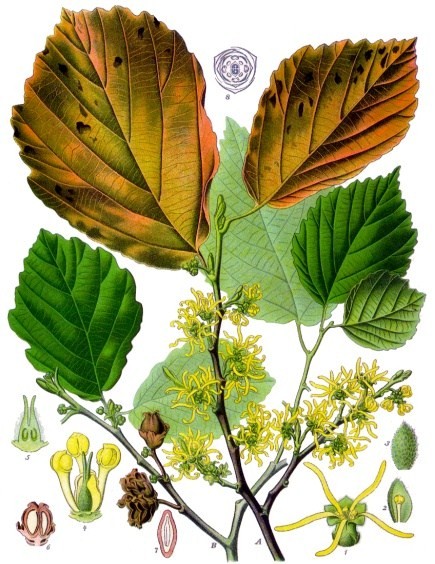
Order: Hamamelidaceae
Description: Hamamelis is a small deciduous tree, up to 5m high, which grows in damp woodland throughout eastern and central US and cultivated elsewhere. It has alternate elliptic, coarsely toothed leaves with prominent veins, often finely hairy underneath Drooping axillary clusters of yellow flowers appear in the autumn when the leaves are falling and give way to a woody capsule ejecting two shiny black seeds the following year.
Parts used: bark and leaf
Collection: the leaves can be gathered throughout summer. The bark is collected in spring after sprouting.
Constituents: Bark: c10% tannin including hamamelitannin, gallic acid, saponins, volatile and fixed oil, resin. Leaves: c6% tannin, flavonoids, volatile oil.
Actions: astringent, haemostatic, antihaemorrhagic, anti-inflammatory, sedative (inner bark), tonic
Indications: diarrhoea, haemorrhoids, varicose veins, mucous colitis, haematemesis, haemoptysis,.
 Therapeutics and Pharmacology: Hamamelis
is used to
contain bleeding and excessive mucous discharge from the alimentary canal. It
may be applied topically for external haemorrhoids, varicose veins, bruises, sprains and
localised inflamed swellings, spots and blemishes. It can also be applied to insect
bites and minor burns such as sunburn. It is most well known in the form of
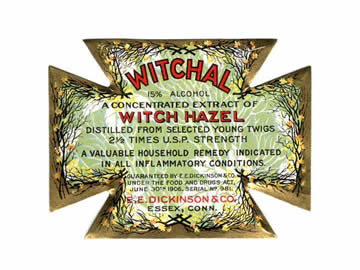
distilled Witch Hazel, which may be used externally and internally, wherever there has been
bleeding. It is an ingredient in eyedrops, aftershave lotions
and cosmetic preparations.
Therapeutics and Pharmacology: Hamamelis
is used to
contain bleeding and excessive mucous discharge from the alimentary canal. It
may be applied topically for external haemorrhoids, varicose veins, bruises, sprains and
localised inflamed swellings, spots and blemishes. It can also be applied to insect
bites and minor burns such as sunburn. It is most well known in the form of
distilled Witch Hazel, which may be used externally and internally, wherever there has been
bleeding. It is an ingredient in eyedrops, aftershave lotions
and cosmetic preparations.
Combinations: Hamamelis can be combined with Ranunculus or Plantago major for the treatment of haemorrhoids and with Agrimonia and Quercus in diarrhoea. Hamamelis Water B.P.C. combines with Calendula as a lotion for localised inflammation. It may be mixed in equal parts with rosewater for a skin tonic.
Preparation and Dosage: (thrice daily)
Regulatory status GSL
Dried leaf: 2g or by infusion
Liquid Extract: 1:1 in 45% alcohol, 2-4ml
Tincture: 2-4ml; dilute for mouthwash
Hamamelis Water B.P.C. locally
Additional Comments: Native Americans used Witch Hazel in poultices for painful swellings and tumours. The distilled witch hazel widely sold is not as astringent as other preparations as it contains no tannins.
Bibliography
BHMA 1983 British Herbal Pharmacopoeia, BHMA, Bournemouth.
Grieve, M. 1931 A Modern Herbal, (ed. C.F. Leyel 1985), London.
Hoffmann, D. 1990 The New Holistic Herbal, Second Edition, Element, Shaftesbury.
Lust, J. 1990 The Herb Book, Bantam, London.
Mabey, R. (ed.) 1991 The Complete New Herbal, Penguin, London.
Mills, S.Y. 1993 The A-Z of Modern Herbalism, Diamond Books, London.
Ody, P. 1993 The Herb Society's Complete Medicinal Herbal, Dorling Kindersley, London.
Weiss, R.F. 1991 Herbal Medicine, Beaconsfield Arcanum, Beaconsfield.
Wren, R.C. 1988 Potter's New Cyclopaedia of Botanical Drugs and Preparations, C.W.Daniel, Saffron Walden.