










Potentilla erecta (L)
Synonyms: Potentilla tormentilla, common
tormentil, bloodroot, septfoil, thormantle, biscuits, shepherd's knapperty, shepherd's
knot, English sarsaparilla, red root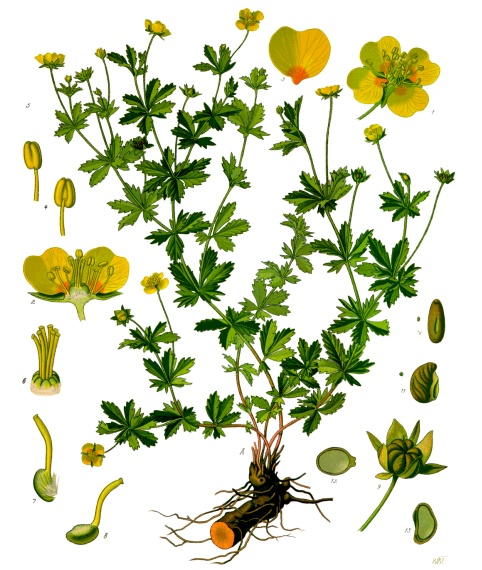
Order: Rosaceae
Description: Potentilla is a perennial found throughout Britain, Europe, western Asia and North Africa in pastures, open woods and moorlands (where it is smaller and more compact), particularly on light acid soils. It hugs the ground beneath other ground cover, and has erect stems with stalked lower and sessile upper leaves of the classic 'cinquefoil' shape). The flowers occur in loose terminal cymes on long slender pedicels, and have four bright yellow petals (other Potentilla species have five petals). The roots are brown, internally reddish, with many scars, pits and elevations, and numerous filamentous rootlets.
Parts used: dried rhizome and herb
Collection: the rhizome is collected in autumn
Constituents: 15% catechol-tannins, bitter glycosides (tormentilline), bitter quinoric acid, resin, gum, red colouring (phlobaphene)
Actions: astringent, antihaemorrhagic, styptic, vulnerary, tonic
Indications: diarrhoea, ulcerative colitis; gargle for throat and mouth; lotion for haemorrhoids
Therapeutics and Pharmacology: Potentilla is a safe and effective astringent remedy, particularly applicable to the gut wall, and is used to treat acute or nervous diarrhoea, enteric irritation, or for the symptomatic relief of ulcerative and mucous colitis. It prevents exacerbation by food of gastritis and peptic ulceration. It is also tonic to the large intestine and is particularly useful in alternating diarrhoea and constipation. It may be used to treat fever - the bitter quinoric acid is also present in Cinchona bark which is used in the treatment of malaria.
Potentilla is a valuable astringent gargle for the mucous membranes of throat and mouth, and is of benefit in the treatment of laryngitis, pharyngitis, bleeding gums and mouth ulcers. The lotion helps ease haemorrhoids, and a douche can be applied to vaginal infections. As an ointment, lotion, compress or poultice it will speed the healing of wounds, cuts and discharging sores. A weak decoction is good for conjunctivitis. It is thought that the red pigment may have a special affinity for bacteria, inhibiting their growth in the same way that aniline dyes are known to do.
Combinations: Potentilla may be combined with Hamamelis Water as a lotion for haemorrhoids. It also combines well with Acacia for diarrhoea. The addition of soothing herbs such as Althaea or Plantago will ease gut inflammation.
Preparation and Dosage: (thrice daily)
Regulatory status GSL
Dried rhizome: 2-4g or by infusion
Liquid extract: 1:1 in 25% alcohol, 2-4ml
Tincture: 1:1 in 45% alcohol, 2-4ml.
Additional Comments: Tormentil is said to derive from the Latin tormentum, referring to the griping pains that it relieves. The plant's astringency made it a valuable tanning agent in the past. The Lapps use the thickened red juice of the root to stain leather. The Americans use the name Tormentil for Geranium maculatum, which has similar properties.
Bibliography
BHMA 1983 British Herbal Pharmacopoeia, BHMA, Bournemouth.
Grieve, M. 1931 A Modern Herbal, (ed. C.F. Leyel 1985), London.
Hoffmann, D. 1990 The New Holistic Herbal, Second Edition, Element, Shaftesbury.
Lust, J. 1990 The Herb Book, Bantam, London.
Mabey, R. (ed.) 1991 The Complete New Herbal, Penguin, London.
Mills, S.Y. 1993 The A-Z of Modern Herbalism, Diamond Books, London.
Ody, P. 1993 The Herb Society's Complete Medicinal Herbal, Dorling Kindersley, London.
Weiss, R.F. 1991 Herbal Medicine, Beaconsfield Arcanum, Beaconsfield.
Wren, R.C. 1988 Potter's New Cyclopaedia of Botanical Drugs and Preparations, C.W.Daniel, Saffron Walden.