










Cassia spp.
Synonyms: Cassia acutifolia (Delile) = C. senna (L.) = Alexandrian senna; Cassia angustifolia (Vahl) = Tinevelly senna; senna pods, senna leaf
Order:
Leguminosae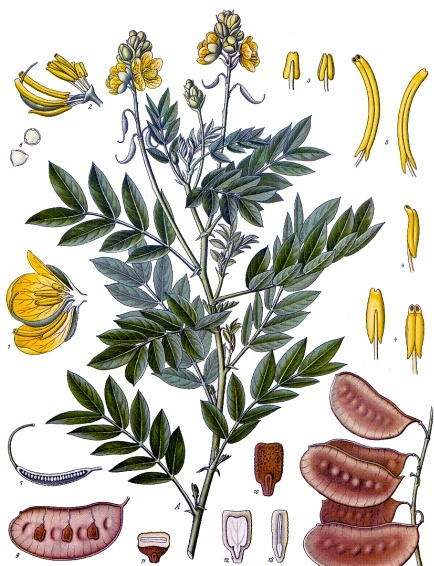
Description: C. acutifolia is native to tropical Africa and cultivated in Egypt and the Sudan and elsewhere, its pale green stems and branches reaching up to 60cm in height. The alternate leaves are even-pinnate, with four or five pairs of lanceolate or obovate leaflets that are brittle and greyish green in colour. The small yellow flowers are characterised by five spreading clawed petals. The fruit is in an oblong pod about 5cm long. C. angustifolia is native to India, Somalia, and Arabia and cultivated mainly in India and Pakistan.
Parts used: dried leaves, dried fruits (pods)
Collection: In September
Constituents: Leaf: anthraquinone glycosides; in the leaf sennosides A and B based on the aglycones sennidin A and sennidin B, sennosides C and D which are glycosides of heterodianthrones of aloe-emodin and rhein. Others include palmidin A, rhein arthrone and aloe-emodin glycosides, some free anthraquinones and some potent compounds of as yet undetermined structure. C. acutifolia usually contains greater amounts of the sennosides. Naphthalene glycosides, flavonoids (especially derivatives of kaempferol and isorhamnetin); mucilage, pinitol and reducing sugars. Fruit: sennosides A and B and a closely related glycoside sennoside A1; naphthalene glycosides; mucilage, flavonoids, volatile oil, sugars, resins
Actions: Fruit: cathartic, stimulating laxative Leaf: laxative, stronger cathartic action than the fruits. Cassia angustifolia is generally weaker in action than C. acutifolia.
Indications: Fruit and leaf: flaccid or atonic constipation and conditions in which easy defaecation with soft stools is desirable, such as anal fissure or haemorrhoids.
Therapeutics and Pharmacology: Senna is a safe and effective laxative used widely throughout the world. The hydroxanthracene glycosides are not absorbed in the upper gut but are converted by the microflora of the large intestine into active aglycones, principally rhein anthrone, which exert a laxative effect on the colon. The mechanism of this action is twofold: stimulation of colonic motility, resulting in augmented propulsion and accelerated colonic transit, reducing the opportunity for fluid absorption from the faeces. It also influences fluid and electrolyte absorption and secretion by the colon, resulting in a net fluid secretion. The mucilage inhibits fluid absorption, enhancing the laxative effect.
Combinations: Fruit and leaf: May be combined with Glycyrrhiza, Zingiber, Elettaria or Foeniculum to increase palatability and prevent griping, which might occur if the herb were taken on its own.
Caution: Fruit and leaf: Cassia is incompatible with cinchona, heavy metal salts, mineral acids, carbonates and lime water. Contraindications include intestinal obstruction, inflammatory bowel disease, appendicitis, and abdominal pains of unknown cause. It is not recommended for tense or spastic constipation. Stimulation of muscle contraction may extend to the uterus, so Cassia should be avoided during pregnancy. Senna leaves are not well tolerated in large doses due to the resins they contain. Infusions should therefore be made with cold water and left to stand for several hours. The constant use of this herb is not advisable since the bowel can become dependent on it.
Preparation and Dosage:
Regulatory Status: GSL Schedule 1
Single dose or two half-doses daily, preferably at bedtime
Fruit: C. acutifolia - 3-6 pods steeped in 150ml water for 6-12 hours
C. angustifolia - 4-12 pods, as above
Liquid Extract BPC (1973): 0.5-2ml
Senna Syrup BPC (1959) 2-8ml
Leaf: Dried leaflets 0.5-2g
Liquid Extract: 1:1 in 25% alcohol, 0.5-2ml
Additional Comments: Senna provides the main ingredient of many pharmaceutical laxatives.
Bibliography
BHMA 1983 British Herbal Pharmacopoeia, BHMA, Bournemouth.
Bradley, P.R. (ed.) 1992 British Herbal Compendium, Volume 1, BHMA, Bournemouth.
Hoffmann, D. 1990 The New Holistic Herbal, Second Edition, Element, Shaftesbury.
Lust, J. 1990 The Herb Book, Bantam, London.
Mabey, R. (ed.) 1991 The Complete New Herbal, Penguin, London.
Mills, S.Y. 1993 The A-Z of Modern Herbalism, Diamond Books, London.
Polunin, M. and Robbins, C. 1992 The Natural Pharmacy, Dorling Kindersley, London.
Weiss, R.F. 1991 Herbal Medicine, Beaconsfield Arcanum, Beaconsfield.
Wren, R.C. 1988 Potter's New Cyclopaedia of Botanical Drugs and Preparations, C.W.Daniel, Saffron Walden.