









Salvia officinalis (L)
Synonyms and Common names: narrow-leaved sage, garden sage, Spanish sage, Salviae folium
German = Salbei, French = Sauge, Spanish = Salvia, Italian = Salvia grande
Order: Labiatae
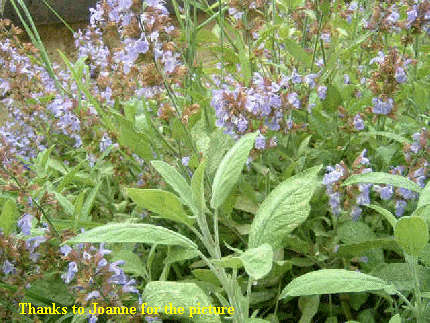 Description: Salvia is a perennial herbaceous to shrubby herb growing up to 50cm in
height. It is native to
the Balkans and the Mediterranean, but is grown widely elsewhere as a garden and pot herb.
It prefers dry chalky soils in sunny areas, but will thrive in a rich loamy soil
with good drainage. It has a woody stem and lower branches which give way to the labiate square stem
which is green or purplish in colour and covered in a fine down. The stalked and
opposite leaves are oblong to lanceolate with a leathery texture, covered in
fine down. The leaf margins are delicately toothed. The blue flowers, which
appear in June and July, occur as whorls in a spike at the end of the stems.
Description: Salvia is a perennial herbaceous to shrubby herb growing up to 50cm in
height. It is native to
the Balkans and the Mediterranean, but is grown widely elsewhere as a garden and pot herb.
It prefers dry chalky soils in sunny areas, but will thrive in a rich loamy soil
with good drainage. It has a woody stem and lower branches which give way to the labiate square stem
which is green or purplish in colour and covered in a fine down. The stalked and
opposite leaves are oblong to lanceolate with a leathery texture, covered in
fine down. The leaf margins are delicately toothed. The blue flowers, which
appear in June and July, occur as whorls in a spike at the end of the stems.
Parts used: the leaves or the entire soft annual shoots; essential oil
Collection: It is usually harvested in May and June, just before flowering. The leaves can be harvested a second time in September.
Constituents: 1-2.5% volatile oil (containing salvene, pinene, camphor, cineole, borneol, 30% thujone, salvene esters and sesquiterpenes), saponins, diterpene bitter principle, flavonoids, phenolic acids, salviatannin (a condensed catechin), oestrogenic substances, resin
Actions: aromatic, carminative, spasmolytic, antiseptic, astringent,
antihidrotic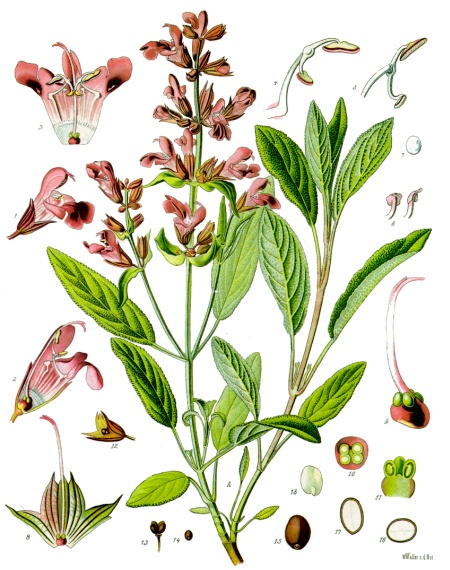
Indications: flatulent dyspepsia, pharyngitis, uvulitis, stomatitis, gingivitis, glossitis, taken internally or as a gargle or mouthwash; hyperhydrosis, galactorrhoea. Specifically indicated in inflammations of the mouth, tongue or throat.
Therapeutics and Pharmacology: The thujone in the volatile oil has an antiseptic and antibiotic action and, when taken as a mouthwash, Salvia deals effectively with throat infections, dental abscesses, infected gums and mouth ulcers. It can also be applied to external wounds. The essential oil, heated in a vaporiser, will disinfect sick-rooms. The phenolic acids in Salvia are particularly potent against Staphylococcus aureus . In vitro, sage oil has been shown to be effective against both gram-positive and Gram-negative bacteria including Escherichia coli and Salmonella species, and against filamentous fungi and yeasts such as Candida albicans. Salvia also has an astringent action due to its relatively high tannin content and can be used in the treatment of infantile diarrhoea. Its antiseptic action is of value where there is intestinal infection. Rosmarinic acid contributes to the herb's anti-inflammatory activity.
Salvia has an antispasmodic action which reduces tension in smooth muscle, and it can be used in a steam inhalation for asthma attacks. It is an excellent remedy for helping to remove mucous congestion in the airways and for checking or preventing secondary infection. It may be taken as a carminative to reduce griping and other symptoms of indigestion, and is also of value in the treatment of dysmenorrhoea. Its bitter component stimulates upper digestive secretions, intestinal mobility, bile flow, and pancreatic function, while the volatile oil has a carminative and stimulating effect on the digestion. The thujone has a vermifuge action. There also seems to be a more general relaxant effect, so that the plant is suitable in the treatment of nervousness, excitability and dizziness. It helps to fortify a generally debilitated nervous system.
Salvia has a strong antihydrotic action, and was a traditional treatment for night sweats in tuberculosis sufferers. Its appreciable oestrogenic effect make it particularly beneficial for the night sweats of the menopause (it should never be used to suppress perspiration in fevers). Its oestrogenic effects may also be used to treat some cases of dysmenorrhoea and menstrual irregularity or amenorrhoea. It is effective in reducing milk production, and can be used during the process of weaning an infant off the breast.
Combinations: Salvia may be combined with Potentilla and Gileadensis as a gargle in throat conditions, or with Filipendula and Chamaemelum in dyspepsia.
Caution: Alcoholic extracts of Salvia have quite a high concentration of thujone which can have toxic effects in large doses. The herb should be avoided during pregnancy because it is a uterine stimulant. The essential oil should always be used with great care as even small doses can be poisonous.
Preparation and Dosage: (thrice daily)
Regulatory Status: GSL Schedule 1
Dried herb: 1-4g or by infusion
Liquid Extract:1:1 in 45% alcohol, 1-4ml
Additional Comments: This herb�s name comes from the Latin salvere, meaning to save. In Chinese medicine it is prescribed for menstrual problems, abdominal pain, insomnia, hepatitis and hives.
Bibliography
Bartram, T. 1995 Encyclopaedia of Herbal Medicine, 1st edn., Grace Publishers, Bournemouth.
BHMA 1983 British Herbal Pharmacopoeia, BHMA, Bournemouth.
Chevallier, A. 1996 The Encyclopaedia of Medicinal Plants, Dorling Kindersley, London.
ESCOP Monograph, 1996 Salviae folium, European Scientific Committee on Phytotherapy
Grieve, M. 1931 A Modern Herbal, (ed. C.F. Leyel 1985), London.
Hoffmann, D. 1990 The New Holistic Herbal, Second Edition, Element, Shaftesbury.
Hyperhealth 1996 Natural Health and Nutrition Databank, v.96.1 CD-ROM, �In-Tele-Health
Lust, J. 1990 The Herb Book, Bantam, London.
Mabey, R. (ed.) 1991 The Complete New Herbal, Penguin, London.
Newall, C.A., Anderson, L.A., & Phillipson, J.D. 1996 Herbal Medicines: A Guide for Health-care Professionals, The Pharmaceutical Press, London.
Ody, P. 1993 The Herb Society's Complete Medicinal Herbal, Dorling Kindersley, London.
Polunin, M. and Robbins, C. 1992 The Natural Pharmacy, Dorling Kindersley, London.
Prihoda, A. 1989 The Healing Powers of Nature, Octopus, London.
Weiss, R.F. 1991 Herbal Medicine, Beaconsfield Arcanum, Beaconsfield.
Wren, R.C. 1988 Potter's New Cyclopaedia of Botanical Drugs and Preparations, C.W.Daniel, Saffron Walden.