




Trifolium pratense (L)
Synonyms and Common names: Wild clover, trefoil, purple clover, cow clover, meadow clover, trefoil,
German = weisenklee, French = Triolet, Spanish = Trebol, Italian = Moscino
Order: Leguminosae
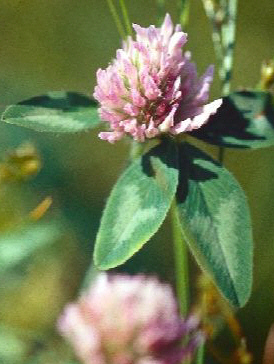
Description: Trifolium is a biennial or perennial plant reaching a height of up to 60cm. It is widespread throughout the world in grassy areas and thrives in the more humid upland areas. It has a short rootstock which produces several simple or slightly branched reddish stems with close-pressed whitish hairs. There is a basal rosette of long-stalked leaves. The stem leaves are alternate, the lower ones long-stalked with oval, tapering stipules, and the upper ones short-stalked to almost sessile. The palmate leaves have three oval to oblong-oval or obovate leaflets which are minutely toothed and sometimes blotched with a whitish crescent towards their base. The globular red to purple flowerheads grow in a dense, ovoid head in the axils of the upper and lateral leaves. Each flowerhead contains thirty to sixty sessile bractless florets. The calyx is hairy and the fruit is a pod.
Parts used: Flowers
Collection: The flowers are gathered between June and September
Constituents: carbohydrates, phenolic glycosides (including trifoliin), isoflavonoids, flavonoids, saponins, salicylates, coumarins, cyanogenic glycosides, volatile oil, fats, mineral acids, resin, vitamins
Actions: Sedative dermatological agent, alterative, expectorant, mildly antispasmodic, relaxant, diuretic, anti-inflammatory, possibly oestrogenic
Indications: chronic skin disease, whooping cough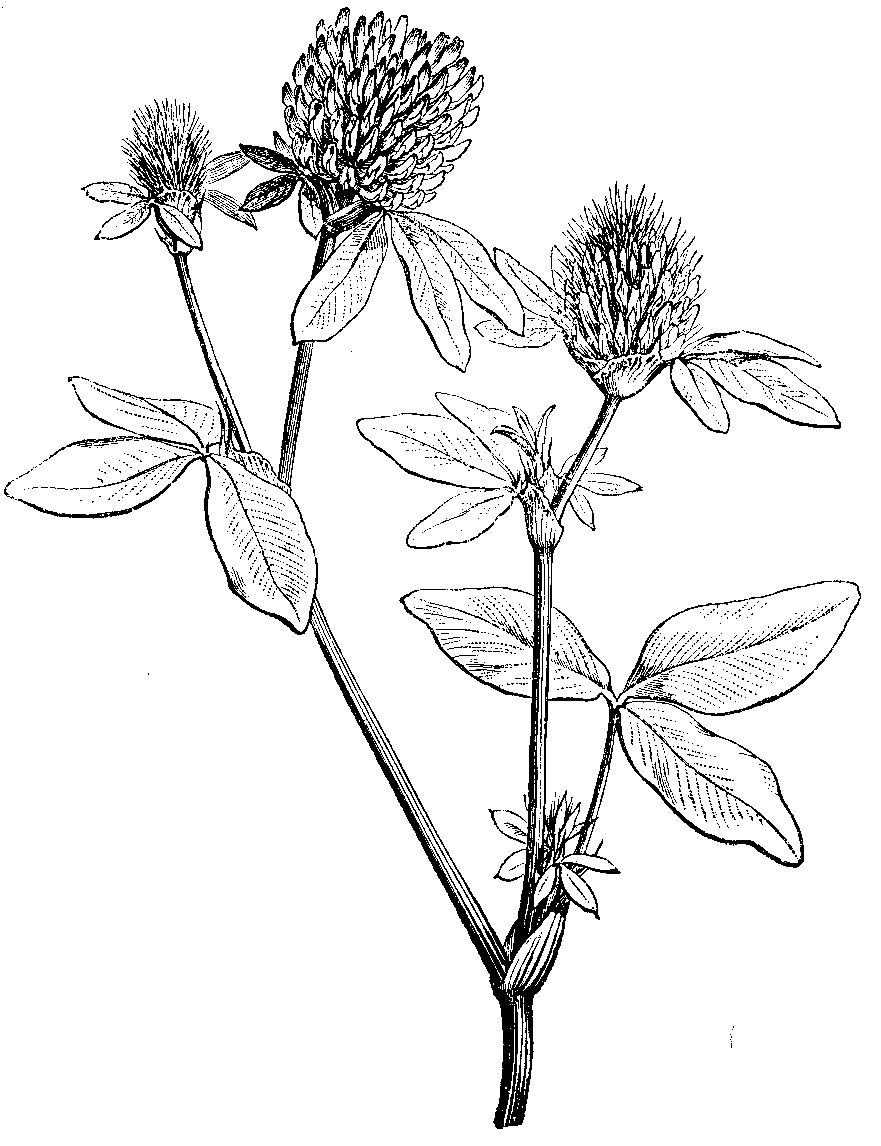
Therapeutics and Pharmacology: This is an excellent remedy for children with skin problems and may be safely used in any case of childhood eczema. It is of particular benefit for children with eczema/asthma syndrome. It is also of value in other chronic skin conditions such as psoriasis. There is some evidence to suggest an antineoplastic action in animals and it has been used in the treatment of cancers, especially of the breasts and ovaries.
The expectorant and antispasmodic actions of this remedy give it a role in the treatment of coughs and bronchitis, but particularly in whooping cough. A syrup made from the infusion relieves stubborn, dry coughs.
The fresh, crushed flowers can be applied to bites and stings; the tincture in water may be used as an eyewash for conjunctivitis. An infusion of the flowers can be applied as a douche to relieve vaginal itching.
Combinations: For skin problems Trifolium combines well with Urtica and Rumex crispus.
Caution: Reported oestrogenic side-effects in grazing animals have been attributed to the isoflavone constituents.
Preparation and Dosage: (thrice daily)
Regulatory Status: GSL Schedule 1
Dried flowers: 4g or by infusion
Liquid Extract: 1:1 in 25% alcohol, 1.5-3ml
Tincture: 1:10 in 45% alcohol, 1-2ml
Additional Comments: According to the Doctrine of Signatures, the white crescentic markings on the leaflets of red clover were seen as a sign that the plant could be of benefit in the treatment of cataracts. The three-lobed leaves were associated with the Holy Trinity by mediaeval Christians. Although red clover is a native European plant, it was not until it became naturalised in North America and the Native Americans had discovered its medicinal properties that it was recognised as a medicine in Europe. The flowers were a popular anti-cancer remedy in the 1930s. Red clover is widely cultivated as animal fodder; the isoflavones are oestrogenic in animals which may ingest large quantities and it has a contraceptive effect on sheep.
Bibliography
Bartram, T. 1995 Encyclopaedia of Herbal Medicine, 1st edn.,Grace Publishers, Bournemouth.
Bradley, P.R. (ed.) 1992 British Herbal Compendium, Volume 1, BHMA, Bournemouth.
Bremness, L. 1994 Herbs, Dorling Kindersley Eyewitness Handbook, London.
BHMA 1983 British Herbal Pharmacopoeia, BHMA, Bournemouth.
Chevallier, A. 1996 The Encyclopaedia of Medicinal Plants, Dorling Kindersley, London.
Grieve, M. 1931 A Modern Herbal, (ed. C.F. Leyel 1985), London.
Hoffmann, D. 1990 The New Holistic Herbal, Second Edition, Element, Shaftesbury.
Lust, J. 1990 The Herb Book, Bantam, London.
Mabey, R. (ed.) 1991 The Complete New Herbal, Penguin, London.
Mills, S.Y. 1993 The A-Z of Modern Herbalism, Diamond Books, London.
Newall, C.A., Anderson, L.A., & Phillipson, J.D. 1996 Herbal Medicines: A Guide for Health-care Professionals, The Pharmaceutical Press, London.
Ody, P. 1993 The Herb Society's Complete Medicinal Herbal, Dorling Kindersley, London.
Polunin, M. and Robbins, C. 1992 The Natural Pharmacy, Dorling Kindersley, London.
Prihoda, A. 1989 The Healing Powers of Nature, Octopus, London.
Wren, R.C. 1988 Potter's New Cyclopaedia of Botanical Drugs and Preparations, C.W.Daniel, Saffron Walden.