










Rubus idaeus (L)
Synonyms: Garden raspberry, European red raspberry, raspbis, hindberry (from Anglo-Saxon Hindbeer), bramble of Mount Ida
Order: Rosaceae
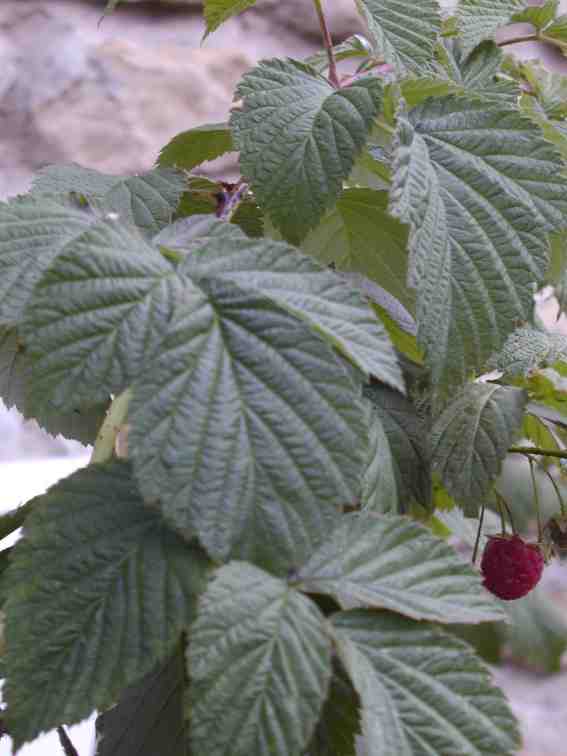
Description: A thorny perennial bush found in woods throughout Britain, Europe and northern Asia and cultivated in most temperate areas. It has a creeping rootstock and biennial, slightly prickly flowering stems up to 1.5m high. The leaves are divided into three to five pointed and toothed leaflets, light green above and whitish underneath; the long panicles of white flowers with short, narrow petals give way to the familiar red fruit.
Parts used: leaves and fruit
Collection: the leaves are collected throughout the growing season but before the fruit ripens; the fruit is collected when ripe.
Constituents: flavonoids (including kaempferol and quercetin), tannins, polypeptides, volatile oil, pectin, citric acid, malic acid, fragarine (uterine tonic). The fruit contains vitamins A, B, C, E, sugars, iron, calcium, phosphorus and volatile oil.
Actions: astringent, tonic, refrigerant, parturient, uterine stimulant, digestive remedy. The fruit is diuretic, laxative, diaphoretic and cleansing.
Indications: diarrhoea, pregnancy, stomatitis; as a gargle for tonsillitis or an eye lotion for conjunctivitis
Therapeutics and Pharmacology: Rubus leaves
have a long tradition of use during pregnancy to strengthen and tone uterine
tissue, assisting contractions and checking haemorrhage during labour. For this
action to occur the herb should be drunk regularly throughout the last trimester
of pregnancy and during labour. The infusion also enriches an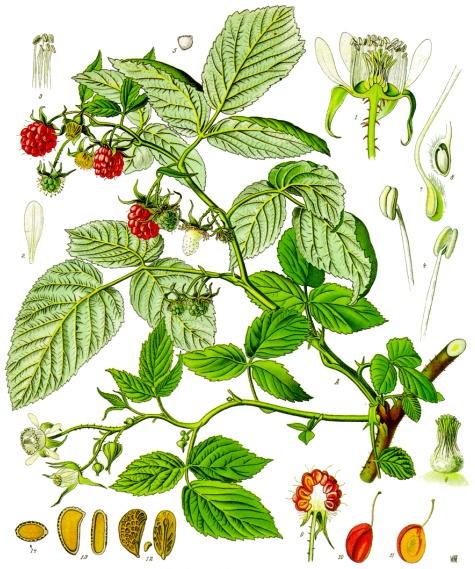 encourages the flow of
breast milk. As an astringent, Rubus may be used in the treatment of diarrhoea,
stomatitis and leucorrhoea, and as a gargle for tonsillitis, a mouthwash for mouth
ulcers, bleeding gums and inflammations, and as an eyewash for conjunctivitis.
The leaves are sometimes included in rheumatic remedies where they have a
diuretic action, and
in France they are regarded as a tonic for the prostate gland. The diluted
tincture may be applied to wounds and inflammations or as a mouthwash for ulcers
and gum inflammations. The berries are traditionally taken for indigestion and
rheumatism. They are rich in nutrients and iron and help combat anaemia.
encourages the flow of
breast milk. As an astringent, Rubus may be used in the treatment of diarrhoea,
stomatitis and leucorrhoea, and as a gargle for tonsillitis, a mouthwash for mouth
ulcers, bleeding gums and inflammations, and as an eyewash for conjunctivitis.
The leaves are sometimes included in rheumatic remedies where they have a
diuretic action, and
in France they are regarded as a tonic for the prostate gland. The diluted
tincture may be applied to wounds and inflammations or as a mouthwash for ulcers
and gum inflammations. The berries are traditionally taken for indigestion and
rheumatism. They are rich in nutrients and iron and help combat anaemia.
Combinations: With Agrimonia and Geum in diarrhoea. With Salvia as a mouthwash or gargle. With Euphrasia as an eye lotion.
Caution: Avoid high doses of the leaves during early pregnancy as they can stimulate uterine contractions.
Preparation and Dosage: (thrice daily)
Regulatory status GSL
Dried leaves: 4-8g or by infusion
Liquid extract: 1:1 in 25% alcohol, 4-8ml.
Additional Comments: Raspberry vinegars were a popular traditional remedy for sore throats and coughs. The juice from the berries has been used in folk medicine as a remedy for fevers, childhood illnesses and cystitis. Gerard believed ' the fruit is good to be given to those that have weake and queasie stomackes'. The fruit is also used for dyeing purposes. In Chinese medicine, raspberry roots and leaves are prescribed for trauma, bone and muscle pain, absent periods and diarrhoea. The wild North American raspberry, R.strigosus may be used in the same way as R. idaeus.
Bibliography
BHMA 1983 British Herbal Pharmacopoeia, BHMA, Bournemouth.
Grieve, M. 1931 A Modern Herbal, (ed. C.F. Leyel 1985), London.
Hoffmann, D. 1990 The New Holistic Herbal, Second Edition, Element, Shaftesbury.
Lust, J. 1990 The Herb Book, Bantam, London.
Mabey, R. (ed.) 1991 The Complete New Herbal, Penguin, London.
Mills, S.Y. 1993 The A-Z of Modern Herbalism, Diamond Books, London.
Ody, P. 1993 The Herb Society's Complete Medicinal Herbal, Dorling Kindersley, London.
Polunin, M. and Robbins, C. 1992 The Natural Pharmacy, Dorling Kindersley, London.
Wren, R.C. 1988 Potter's New Cyclopaedia of Botanical Drugs and Preparations, C.W.Daniel, Saffron Walden.