









Stillingia sylvatica (L)
Synonyms: Queen's root, yawroot, cockup hat, marcory, silver root, silver leaf, pavil
Order: Euphorbiaceae
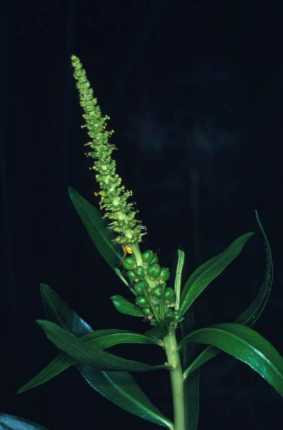
Description: Stillingia is a perennial, growing up to 1.5m tall in acid and sandy soils in the southern United States of Florida, Virginia and Texas. It has alternate leathery, sessile leaves and a terminal spike of yellow flowers. The fruit is a three-lobed capsule.
Parts used: root (not more than two years old)
Collection: the root is unearthed after flowering in July
Constituents: volatile oil (up to 4%), acrid resin (sylvacrol), acrid fixed oil, tannins (10-12%), calcium oxalate, cyanogenic glycosides, starch
Actions: sialagogue, expectorant, alterative, dermatological agent, diaphoretic, astringent, antispasmodic, circulatory stimulant, laxative, cathartic in large doses.
Indications: bronchitis, laryngitis, laryngismus stridulus, cutaneous eruptions, haemorrhoids, constipation
Therapeutics and Pharmacology: Stillingia is of value in the treatment of chronic exudative skin conditions such as eczema and psoriasis, and is specifically indicated where there is lymphatic involvement. Treatment is likely to be fairly long-term. It is also used to treat bronchitic congestion and laryngitis, especially when accompanied by loss of voice (laryngismus stridulus); it may also be used to treat croup when the cough is harsh (the herb helps promote the flow of saliva). It will help to relieve constipation and, as an astringent, it is particularly of benefit for haemorrhoids.
Combinations: For the treatment of skin problems Stillingia combines well with Arctium, Rumex, Fumaria, Galium and Iris. It may also be used with Lobelia, Sanguinaria, Pimpinella and Eucalyptus in laryngismus stridulus and bronchitis.
Caution: Large doses of Stillingia can irritate the skin and mucous membranes, and it is a powerful sternutatory herb. It can also be cathartic and emetic and should always be used with care. It should not be stored for more than two years.
Preparation and Dosage: (thrice daily)
Regulatory Status: GSL
Dried root: 1-2g or by decoction
Liquid Extract: 1:1 in 25% alcohol, 0.5-2ml
Tincture: 1:5 in 45% alcohol, 1-4ml
Additional Comments: Stillingia was once thought to be a reliable cure for syphilis (which it is not), the decoction being used to treat continuing pain and ulceration after mercurial treatment.
Bibliography
BHMA 1983 British Herbal Pharmacopoeia, BHMA, Bournemouth.
Grieve, M. 1931 A Modern Herbal, (ed. C.F. Leyel 1985), London.
Hoffmann, D. 1990 The New Holistic Herbal, Second Edition, Element, Shaftesbury.
Lust, J. 1990 The Herb Book, Bantam, London.
Mabey, R. (ed.) 1991 The Complete New Herbal, Penguin, London.
Mills, S.Y. 1993 The A-Z of Modern Herbalism, Diamond Books, London.
Moore, M. 1989 Medicinal Plants of the Desert and Canyon West, Museum of New Mexico Press, Santa Fe.
Wren, R.C. 1988 Potter's New Cyclopaedia of Botanical Drugs and Preparations, C.W.Daniel, Saffron Walden.