










Sinapsis alba/nigra (L)
 Synonyms: Brassica nigra (L.), Brassica
alba (Boiss.)
Synonyms: Brassica nigra (L.), Brassica
alba (Boiss.)
Order: Cruciferae
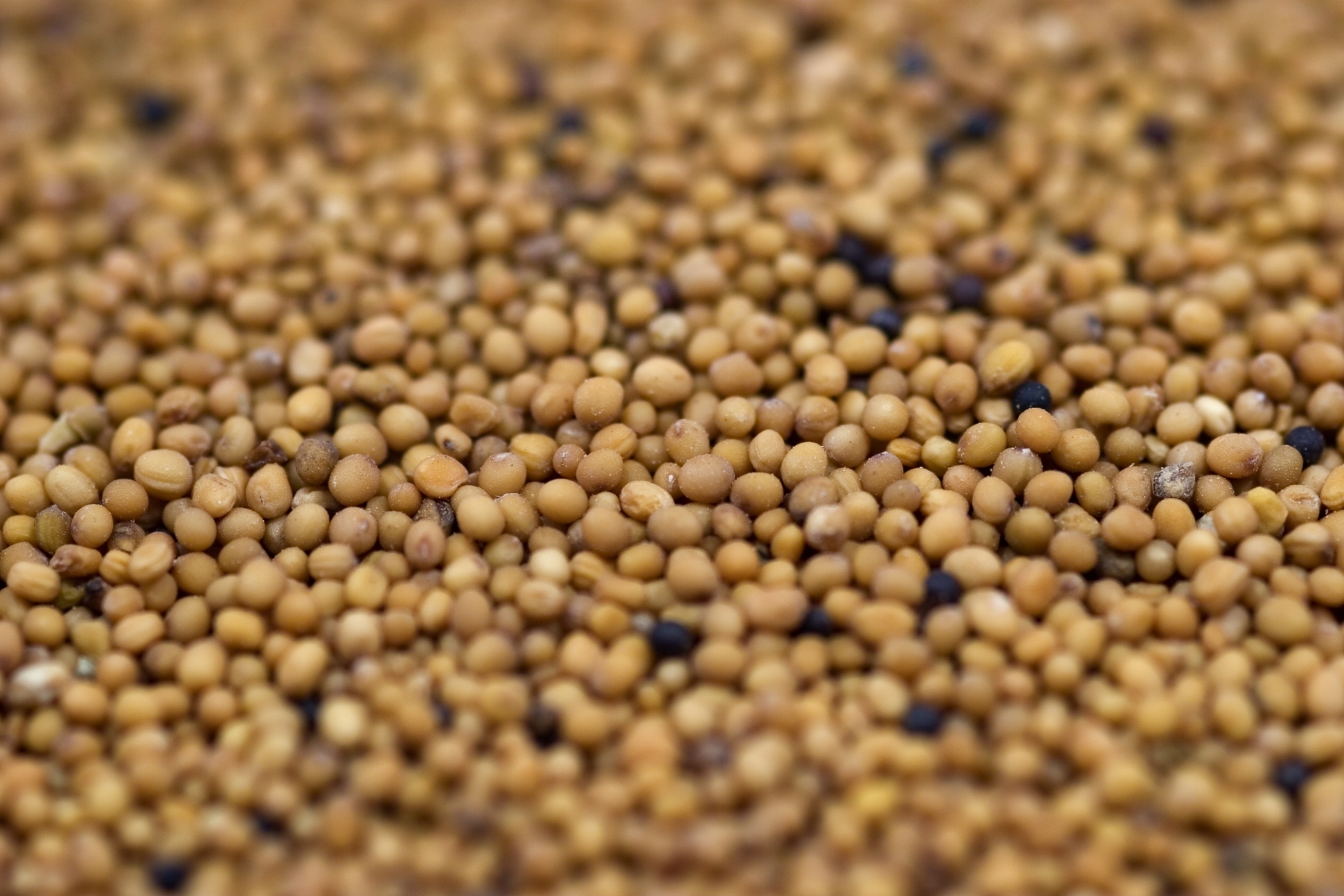
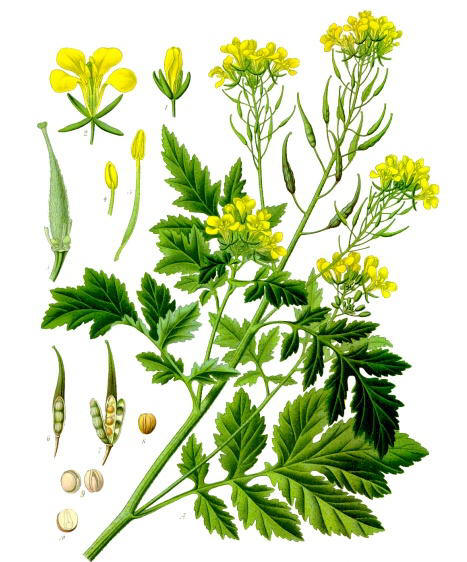
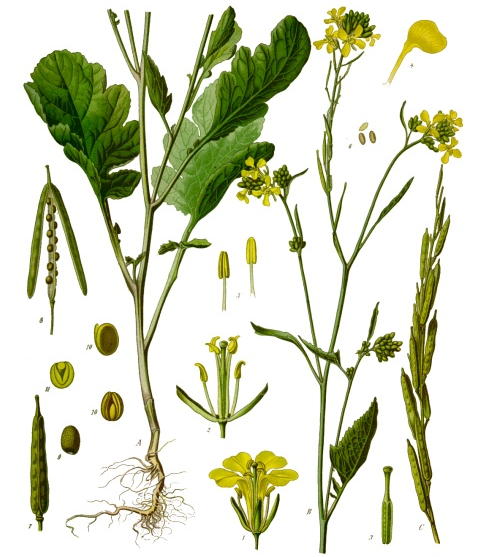
Description: Sinapsis nigra is a widely cultivated annual, also found wild in many parts of the world. The branching, angular stem grows up to 2m tall and bears alternate leaves, the lower ones lyrately pinnatifid and somewhat bristly, the upper ones glabrous, entire and lanceolate. Yellow flowers grow in terminal racemes from June to November. The black seeds develop in bulgy, cylindrical pods which are closely pressed to the stem. They are globular, 1-2mm diameter. Sinapsis alba is also widely cultivated but also found as a weed in many parts of the world. The branched, angular, bristly-haired stem may grow as high as 1.3m and bears leaves varying from pinnate with a large terminal lobe near the bottom of the plant to simple, irregularly round-lobed, oblong-ovate leaves on the stem. Yellow flowers grow on a slender terminal raceme from June to August. The white to yellowish seeds, which are up to 2.5mm in diameter, grow in pods which are tipped with a long beak and which stand out from the stem.
Part used: seeds, oil
Collection: the ripe seed pods are collected in late summer and the seeds tapped out
Constituents: mucilage, fixed oil, volatile oil, sinigrin.
Actions: rubefacient, counter-irritant, vesicant, stimulant, diuretic, emetic.
Indications: external application for rheumatic pain and bronchitis
 Therapeutics and Pharmacology: Sinapsis
is a stimulating external application, the rubefacient action causing mild irritation
to the skin, stimulating the circulation to that area and relieving muscular and
skeletal pain, sciatica, neuralgia and various internal inflammations. Mustard oil can be mixed with rectified alcohol
(1:40 oil to alcohol) and used as a lotion for gouty pains, lumbago and rheumatism. Mustard
oils are absorbed through the skin and eliminated via the lung, so that the
antibacterial action can take effect there. The diluted oil may be taken in small
amounts internally to promote the appetite and stimulate the flow of digestive juices.
The stimulating, diaphoretic action can be utilised in feverishness, colds and influenza,
where the seeds may be taken as a tea or ground and sprinkled into a bath.
An infusion or poultice will aid in cases of bronchitis and pleurisy (Sinapsis
alba in particular). Whole Sinapsis alba seeds are sometimes taken as a purgative.
Therapeutics and Pharmacology: Sinapsis
is a stimulating external application, the rubefacient action causing mild irritation
to the skin, stimulating the circulation to that area and relieving muscular and
skeletal pain, sciatica, neuralgia and various internal inflammations. Mustard oil can be mixed with rectified alcohol
(1:40 oil to alcohol) and used as a lotion for gouty pains, lumbago and rheumatism. Mustard
oils are absorbed through the skin and eliminated via the lung, so that the
antibacterial action can take effect there. The diluted oil may be taken in small
amounts internally to promote the appetite and stimulate the flow of digestive juices.
The stimulating, diaphoretic action can be utilised in feverishness, colds and influenza,
where the seeds may be taken as a tea or ground and sprinkled into a bath.
An infusion or poultice will aid in cases of bronchitis and pleurisy (Sinapsis
alba in particular). Whole Sinapsis alba seeds are sometimes taken as a purgative.
Caution: large amounts or prolonged use internally or externally can cause serious irritation and inflammation. Undiluted mustard oil must never be used , and it should never be used on sensitive areas.
Preparation and Dosage:
Regulatory Status: Volatile oil - GSL for external use only (at restricted strength).
Poultice: Mix 100g freshly ground mustard seeds with warm water to form a thick paste. Spread on a piece of cloth the size of the body area to be covered. To stop paste sticking to skin, apply a piece of dampened gauze. Apply cloth and remove after one minute.
Infusion: pour a cup of boiling water onto 1 teaspoon of ground mustard seed and infuse for 5 minutes. Drink three times a day.
Foot bath: Make an infusion with 1 litre boiling water to 1 tablespoon bruised seeds.
 Additional comments: Hippocrates recommended
the seeds of white mustard both internally and as a counter-irritating poultice,
made with vinegar.
Additional comments: Hippocrates recommended
the seeds of white mustard both internally and as a counter-irritating poultice,
made with vinegar.
Bibliography
Grieve, M. 1931 A Modern Herbal, (ed. C.F. Leyel 1985), London.
Hoffmann, D. 1990 The New Holistic Herbal, Second Edition, Element, Shaftesbury.
Lust, J. 1990 The Herb Book, Bantam, London.
Richardson, R. 1988 The Little Spice Book, Piatkus, Loughton.
Weiss, R.F. 1991 Herbal Medicine, Beaconsfield Arcanum, Beaconsfield.
Wren, R.C. 1988 Potter's New Cyclopaedia of Botanical Drugs and Preparations, C.W.Daniel, Saffron Walden.