









Calendula officinalis (L)
Synonyms and Common names: Pot marigold, Mary bud, Mary gold, gold bloom, Garden marigold, holigold, golds, ruddes, ruddles, Mary Gowles, Oculus Christi
French = Souci des jardins, German = Ringelblume, Spanish = Calendula, Italian = Calendola
 Order: Compositae
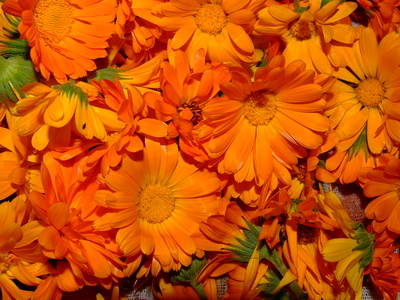
Description: Calendula is an annual plant with angular branched stems and prominent pale green spatulate or oblanceolate sessile leaves with widely spaced teeth. The whole plant stands 30-60cm high. The bright orange or yellow flowers are borne on a crown-shaped receptacle and, as the petals drop off, a circular corona of seeds remains. It is a native of Egypt and the Mediterranean, but has become naturalised throughout temperate regions of the world, often in previously cultivated land. Many cultivated varieties of marigold come from completely different genera and these should be distinguished from Calendula officinalis.
Parts used: dried flower heads or petals
Collection: The whole flower tops or just the petals are collected between June and September. To prevent discolouration, they should be carefully dried in the shade and stored in well-sealed containers.
Constituents: Triterpenoid saponins (sapogenin: oleonolic acid), carotenoids (pro-vitamin A), bitter glycosides, a yellow resin calendulin, volatile oil, sterols, flavonoids, mucilage, carotenoid pigments
Actions: Spasmolytic, mild diaphoretic, anti-inflammatory, antihaemorrhagic, non-tannin astringent, styptic, vulnerary, local tissue healer, antifungal, antiseptic, cholagogue, emmenagogue, menstrual regulator.
Indications: inflammations of the skin and mucosa
Therapeutics and Pharmacology: Calendula is
an extremely effective herb for the treatment of skin problems and can be used wherever
there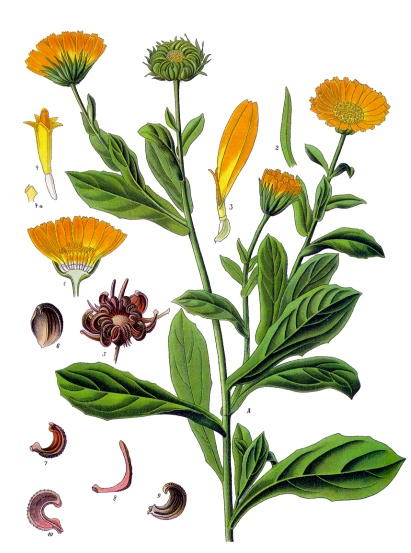 is inflammation of the skin, whether due to infection or physical damage;
for example, crural ulceration, varicose veins, haemorrhoids, anal
fissures, mastitis, sebaceous cysts, impetigo or other
inflamed cutaneous lesions. It is also specifically indicated in enlarged or
inflamed lymphatic nodes. It may be used externally for any wound,
bruising or strains and is of particular value in the treatment of slow-healing
wounds and skin ulcers or as a first aid treatment of minor burns and scalds.
Calendula has been shown to promote blood clotting and to reduce capillary
effusion. As an eye lotion, it can be used to treat conjunctivitis. Topical
application may be as a lotion, poultice or compress. As an ointment, it is an
excellent cosmetic remedy for repairing minor damage to the skin such as
subdermal broken capillaries or sunburn. The sap from the stem is reputed to
remove warts, corns and calluses. Isolated polysaccharides from the flowers were found to stimulate
phagocytosis of human granulocytes in vitro. Although it contains no
tannins, Calendula is locally astringent, due to its resin component and
probably to other water-soluble constituents as well.
is inflammation of the skin, whether due to infection or physical damage;
for example, crural ulceration, varicose veins, haemorrhoids, anal
fissures, mastitis, sebaceous cysts, impetigo or other
inflamed cutaneous lesions. It is also specifically indicated in enlarged or
inflamed lymphatic nodes. It may be used externally for any wound,
bruising or strains and is of particular value in the treatment of slow-healing
wounds and skin ulcers or as a first aid treatment of minor burns and scalds.
Calendula has been shown to promote blood clotting and to reduce capillary
effusion. As an eye lotion, it can be used to treat conjunctivitis. Topical
application may be as a lotion, poultice or compress. As an ointment, it is an
excellent cosmetic remedy for repairing minor damage to the skin such as
subdermal broken capillaries or sunburn. The sap from the stem is reputed to
remove warts, corns and calluses. Isolated polysaccharides from the flowers were found to stimulate
phagocytosis of human granulocytes in vitro. Although it contains no
tannins, Calendula is locally astringent, due to its resin component and
probably to other water-soluble constituents as well.
The plant acts against fungal, protozoal, bacterial and viral infections. Antifungal activity has been demonstrated in vitro with a 10% methanol extract, and a 70% hydro-alcoholic tincture had high virucidal activity against influenza viruses and suppressed the growth of herpes simplex virus. The oxygenated terpenes are active against trichomonas. Tincture of Calendula tincture, particularly when combined with Commiphora, is an effective local treatment for fungal and other infections of the vagina, or for fungal skin conditions.
Taken internally, Calendula is of benefit in digestive inflammation, for example, gastric or duodenal ulcers. It is indicated in unresolved infection or erosion of the upper digestive tract, particularly where there is evidence of bleeding into the gut (i.e. the dark stools of melaena). As a cholagogue it helps relieve gallbladder problems and to aid the digestion generally.
As an emmenagogue, Calendula can be of benefit in the treatment of delayed menstruation and dysmenorrhoea. The hormonal influences are likely to stem from the sterol fraction.
Combinations: For digestive problems Calendula may be combined with Althaea radix and Geranium. As an external soothing application for cuts, bruises, burns and scalds, it can be combined with Ulmus and Chondrus. An antiseptic lotion can be produced by combining it with Hydrastis and Commiphora. It also combines well with Distilled Water of Witch Hazel as a lotion for varicose veins.
Preparation and Dosage: (thrice daily)
Regulatory Status: GSL Schedule 1
Dried florets: 1-4g or by infusion
Liquid Extract: 1:1 in 40% alcohol, 0.5-1ml
Tincture: (B.P.C. 1934) 1:5 in 90% alcohol, 0.3-1.2ml
Additional Comments: In the 12th century Macer wrote that merely looking at the plant would improve the eyesight, clear the head and encourage cheerfulness. Culpeper recommended it to 'strengthen the heart', and it was highly regarded in the treatment of smallpox and measles. Today Calendula is widely used in homoeopathic remedies, where it is prescribed for coughs, the common cold, fever, wounds and chronic infections. Such large amounts are grown for medicinal use in the former Soviet Union that it has earned the name of Russian penicillin. The leaves and petals can be eaten in salads, and the flowers are widely used in cosmetics. The bright hues also make beautiful accessories for girls' costumes or fancy dress up. Traditionally the flowers were used to impart a yellow colour to cheese.
Bibliography
Bartram, T. 1995 Encyclopaedia of Herbal Medicine, 1st edn., Grace Publishers, Bournemouth.
Bremness, L. 1994 Herbs, Dorling Kindersley Eyewitness Handbook, London.
BHMA 1983 British Herbal Pharmacopoeia, BHMA, Bournemouth.
Chevallier, A. 1996 The Encyclopaedia of Medicinal Plants, Dorling Kindersley, London.
Grieve, M. 1931 A Modern Herbal, (ed. C.F. Leyel 1985), London.
Hoffmann, D. 1990 The New Holistic Herbal, Second Edition, Element, Shaftesbury.
Hyperhealth 1996 Natural Health and Nutrition Databank, v.96.1 CD-ROM, �In-Tele-Health, available from Healthworks, Leeds. ISBN 0-646-30942-0
Lust, J. 1990 The Herb Book, Bantam, London.
Mabey, R. (ed.) 1991 The Complete New Herbal, Penguin, London.
Mills, S.Y. 1993 The Essential Book of Herbal Medicine, Penguin, London (First published in 1991 as Out of the Earth, Arkana)
Mills, S.Y. 1993 The A-Z of Modern Herbalism, Diamond Books, London.
Newall, C.A., Anderson, L.A., & Phillipson, J.D. 1996 Herbal Medicines: A Guide for Health-care Professionals, The Pharmaceutical Press, London.
Ody, P. 1993 The Herb Society's Complete Medicinal Herbal, Dorling Kindersley, London.
Polunin, M. and Robbins, C. 1992 The Natural Pharmacy, Dorling Kindersley, London.
Prihoda, A. 1989 The Healing Powers of Nature, Octopus, London.
Rogers, S.K. 1995 British and Chinese Herbal Pharmacopoeia, Healthlink Software Systems, Australia
Weiss, R.F. 1991 Herbal Medicine, Beaconsfield Arcanum, Beaconsfield.
Wren, R.C. 1988 Potter's New Cyclopaedia of Botanical Drugs and Preparations, C.W.Daniel, Saffron Walden.