










Lobelia inflata (L)
Synonyms: lobelia, bladderpod, emetic herb, emetic weed, gagroot, vomitroot, vomitwort, pukeweed, wild tobacco, asthma weed, bladderpod, eyebright
Order: Lobeliaceae
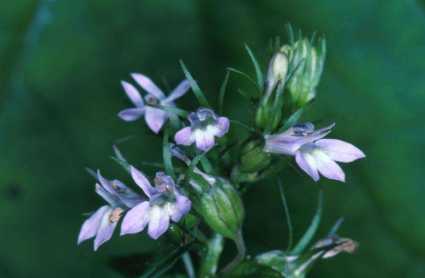
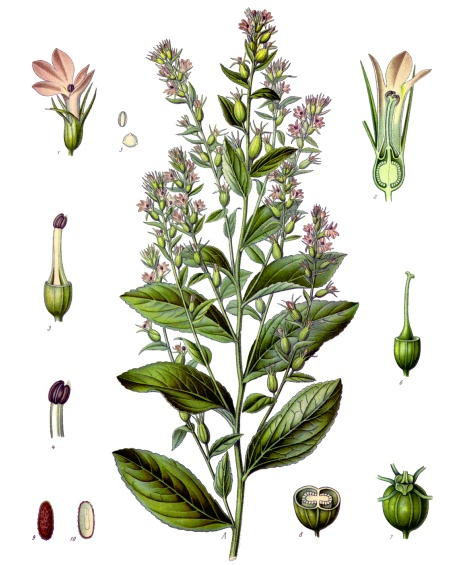
Description: This annual or biennial herb is indigenous to the eastern US and grows in meadows, pastures and cultivated fields. The erect, angular stem, growing up to 1m high, is hairy and contains a milky sap. The thin, light green leaves are alternate, hairy, ovate, and bluntly serrate. Numerous small, two-lipped, blue flowers grow in spike-like racemes from July to November. The fruit is a two-celled capsule filled with small brown seeds.
Parts used: dried aerial parts, and seeds.
Collection: after flowering, when the lower fruits are nearly ripe and dried (between August and September), the entire aerial plant including the seed pods should be collected.
Constituents: Piperidine alkaloids (including lobeline, isolobinine, lobelanine, lobelanidine), carboxylic acids, bitter glycoside (lobelacrin), pungent volatile oil (lobelianin), resin, gum, fats, chelidonic acid
 Actions: respiratory stimulant,
anti-asthmatic, spasmolytic, expectorant, diaphoretic, nervine, emetic,
relaxant.
Actions: respiratory stimulant,
anti-asthmatic, spasmolytic, expectorant, diaphoretic, nervine, emetic,
relaxant.
Indications: spasmodic asthma with secondary bronchitis; chronic bronchitis; spastic colon, spastic muscle conditions; topically for myositis, rheumatic nodules.
Therapeutics and Pharmacology: Lobelia's primary use is as an antispasmodic remedy in bronchitic asthma and bronchitis. In the past, it was also used to induce vomiting. The alkaloids have a paradoxical effect on the respiratory system - lobeline is a powerful respiratory stimulant whilst isolobelanine is an emetic and respiratory relaxant, stimulating catarrhal secretions and expectoration whilst relaxing the muscles of the respiratory system. At therapeutic levels, lobeline acts on the chemoreceptors of the glomus caroticus, causing reflex stimulation of the respiratory centre. Since it is rapidly metabolised, its effects are transitory when taken orally and topical application is often more effective. It has many of the pharmalogical properties of nicotine, first stimulating the central nervous system and then subsequently strongly depressing it. Lobelia has a relaxing and diffusive influence in inflamed, febrile, hypersensitive and irritable conditions; it has a generally depressant action on the central and autonomic nervous system and on neuro-muscular action.
Externally, the plant can be made into a poultice or liniment for bruises, insect bites, sprains, ringworm, erysipelas and poison ivy irritation.
Combinations: with Capsicum, Grindelia, Drosera, Symplocarpus, Euphorbia and Ephedra in asthma. It is frequently a constituent of prescriptions designed to manage or contain acute inflammatory, allergic or hypersensitivity syndromes, and in fever management. It may be used with equal amounts of Slippery Elm Powder as a poultice.
Caution: Overdosage may cause nausea and vomiting, profuse sweating, paresis, tachycardia, hypotension and coma; fatalities have occurred. Contraindicated in pregnancy. Lobelia should be used only under the supervision of a qualified practitioner.
Preparation and Dosage: (thrice daily)
Regulatory Status: GSL up to 65mg per single dose; herbal practitioners up to 200mg per dose.
Dried herb: 50-200mg or by infusion or decoction
Liquid extract: 1:1 in 50% alcohol, 0.2-0.6ml
Tincture: 1:8 in 60% alcohol, 0.4-1.6ml
Topically in plasters, ointments, lotions or suppositories of equivalent dosage.
Treatment should commence at the lower level of dosage until patient's response is known.
Additional Comments: The herb is named after the botanist Matthias de Lobel. It was highly regarded by the Physiomedicalists as their major relaxant remedy They used it to treat pain caused by spasm. It first appeared in Europe in 1829. Native Americans smoked it instead of tobacco and also to treat asthma and related respiratory problems; today it is sometimes used to help reduce nicotine addiction and tobacco withdrawal symptoms, similar to how meditation techniques or hypnosis are used for the same purpose. Blue lobelia (L. siphilitica) is used in homeopathic medicine for diarrhoea.
Bibliography
Bradley, P.R. (ed.) 1992 British Herbal Compendium, Volume 1, BHMA, Bournemouth.
BHMA 1983 British Herbal Pharmacopoeia, BHMA, Bournemouth.
Grieve, M. 1931 A Modern Herbal, (ed. C.F. Leyel 1985), London.
Hoffmann, D. 1990 The New Holistic Herbal, Second Edition, Element, Shaftesbury.
Lust, J. 1990 The Herb Book, Bantam, London.
Mabey, R. (ed.) 1991 The Complete New Herbal, Penguin, London.
Mills, S.Y. 1993 The A-Z of Modern Herbalism, Diamond Books, London.
Ody, P. 1993 The Herb Society's Complete Medicinal Herbal, Dorling Kindersley, London.
Polunin, M. and Robbins, C. 1992 The Natural Pharmacy, Dorling Kindersley, London.
Wren, R.C. 1988 Potter's New Cyclopaedia of Botanical Drugs and Preparations, C.W.Daniel, Saffron Walden.