





Hyoscyamus niger (L)
Synonyms and Common names: Hyoscyami folium, black henbane, devil's eye, foetid nightshade, henbell (Anglo-Saxon), hog bean, Jupiter's bean, poison tobacco, stinking nightshade, symphonica, cassilato, cassilago.
German = Schwarzes bilsenkraut, French = Jusquiame noire, Spanish = Beteno, Italian = Jusquiame nero, Chinese = lang-tang
Order: Solanaceae
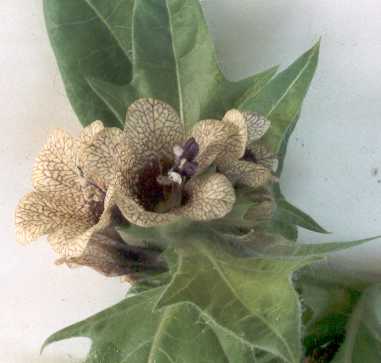
Description: Hyoscyamus is a slightly sticky, hairy annual or biennial. A rosette of basal leaves grows in the first year, followed in the second year by an erect, simple or slightly branched stem, up to 80cm tall and covered with sticky hairs. The alternate leaves are oval, deeply toothed and lobed-pinnate to indented. The lower leaves are stalked, the upper semi-enclosing. Sessile flowers grow from the axils of the upper leaves and have a bell-shaped, glandularly hairy, markedly veined calyx running into five sharply pointed tips and a funnel-shaped, dirty yellow, externally hairy corolla with violet veins and a reddish-violet mouth. The fruit capsules contain up to five hundred greyish-brown seeds. The plant grows in waste places and disturbed ground in Britain and Europe, mainly on lowlands. Over-wintering plants flower in May and June, the annuals in July and August. All parts of the plant are poisonous. The taste and odour are unpleasant and characteristic.
Parts used: the leaves and flowering tops; occasionally the fruits
Collection: during the flowering period
Constituents: 0.03-0.15% tropane alkaloids (hyoscyamine,
hyoscine = scopolamine), flavonol glycosides (quercitin, rutin, kaempferol),
small amounts of volatile amines (choline, methylpyrroline, pyridine). Egyptian henbane, H. muticus, contains higher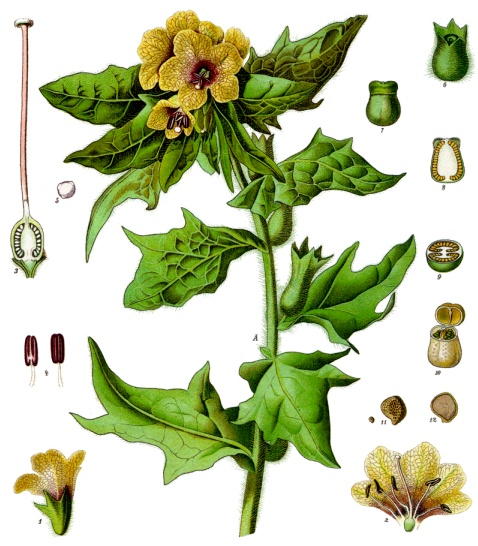 concentrations of
alkaloids.
concentrations of
alkaloids.
Actions: antispasmodic, anodyne, sedative, mydriatic.
Indications: spasm of the urinary tract, griping due to purgatives, geriatric tremors (e.g. in Parkinson�s disease); topically analgesic and anti-inflammatory
Therapeutics and Pharmacology: The alkaloids in Hyoscyamus are parasympatholytic, competitively inhibiting the neurotransmitter acetylcholine. Its action is similar to that of Atropa belladonna, although the higher proportion of hyoscine in Hyoscyamus makes cerebral excitement less likely. It has peripheral effects on the autonomic nervous system and sedative effects on the central nervous system. Hyoscyamus is used mainly for its antispasmodic effect on the digestive and urinary tracts, and to counteract griping due to purgatives. Its sedative and antispasmodic actions make it a valuable treatment for Parkinson�s disease, relieving tremor and rigidity in the early stages of the disease.
Hyoscyamine and hyoscine cause a decrease in sweat, salivary, gastric and bronchial secretions, decrease the tone and motility of smooth muscle in the digestive and urinary tracts, and increase the pulse rate. Hyoscyamus is an ingredient of some antiasthmatic smoking mixtures and herbal cigarettes. The alkaloid hyoscine is used very widely as a pre-operative medication and a travel sickness preventative.
Because of the danger of poisoning, this herb is used primarily for external applications. An oil obtained from the leaves is made into anodyne lotions for earache, neuralgia, sciatica and rheumatism.
Caution: Hyoscyamus is contraindicated in tachycardiac arrhythmia and glaucoma. It should be used only under medical supervision. Overdosage (which is close to the therapeutic dose) causes dry mouth, dysphagia, pupil dilation, tachycardia, restlessness, hallucinations, delirium and coma. Children have been poisoned by eating the seeds.
Preparation and Dosage: (thrice daily)
Regulatory status: POM (herbal practitioners exempted up to 100mg per dose)
Dried leaf: 100-150mg by infusion
Prepared Hyoscyamus BP (containing 0.05% of total alkaloids), 100-200mg
Hyoscyamus Dry Extract B.P.C.: 15-60mg
Hyoscyamus Liquid Extract B.P.C.: 0.2-0.5ml
Hyoscyamus Tincture BP (1:10 in 70% alcohol): 2-5ml
Additional Comments: Henbane has a long association with soothsaying, magic and witchcraft. It was once believed to have aphrodisiac properties and was an ingredient of love potions. The Egyptians smoked it to relieve toothache. The ancient Greeks believed that people under the influence of the herb became prophetic, and the priestesses of the Oracle of Delphi are claimed to have inhaled the smoke from smouldering henbane. In mythology, the dead in Hades were crowned with it as they wandered hopelessly beside the Styx. Hamlet's father was murdered when a distillation of henbane was poured in his ear. The homoeopathic remedy Hyoscyamus is prescribed for twitching, coughs, sensitive skin, and excited or obsessional behavioural problems.
Bibliography
Bartram, T. 1995 Encyclopaedia of Herbal Medicine, 1st edn., Grace Publishers, Bournemouth.
Bradley, P.R. (ed.) 1992 British Herbal Compendium, Volume 1, BHMA, Bournemouth.
Bremness, L. 1994 Herbs, Dorling Kindersley Eyewitness Handbook, London.
Chevallier, A. 1996 The Encyclopaedia of Medicinal Plants, Dorling Kindersley, London.
Grieve, M. 1931 A Modern Herbal, (ed. C.F. Leyel 1985), London.
Lust, J. 1990 The Herb Book, Bantam, London.
Mann, J. 1992 Murder, Magic and Medicine, Oxford University Press.
Polunin, M. and Robbins, C. 1992 The Natural Pharmacy, Dorling Kindersley, London.
Prihoda, A. 1989 The Healing Powers of Nature, Octopus, London.
Weiss, R.F. 1991 Herbal Medicine, Beaconsfield Arcanum, Beaconsfield.
Wren, R.C. 1988 Potter's New Cyclopaedia of Botanical Drugs and Preparations, C.W.Daniel, Saffron Walden.