









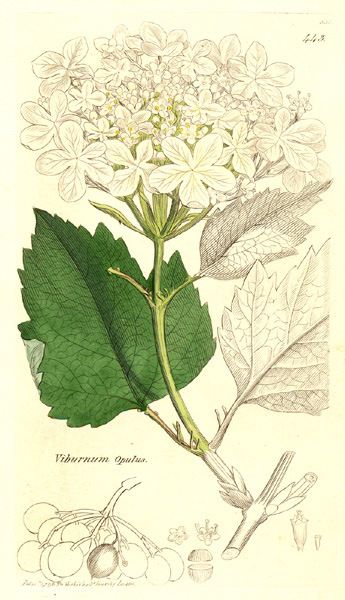
Viburnum opulus (L)
 Synonyms: V. americanum (Miller), European cranberry, cramp bark,
snowball tree, king's Crown, high cranberry, red elder, rose elder, water elder,
May rose, Whitsun rose, dog rowan tree, silver bells, Whitsun bosses, gaitre berries
Synonyms: V. americanum (Miller), European cranberry, cramp bark,
snowball tree, king's Crown, high cranberry, red elder, rose elder, water elder,
May rose, Whitsun rose, dog rowan tree, silver bells, Whitsun bosses, gaitre berries
Order: Caprifoliaceae
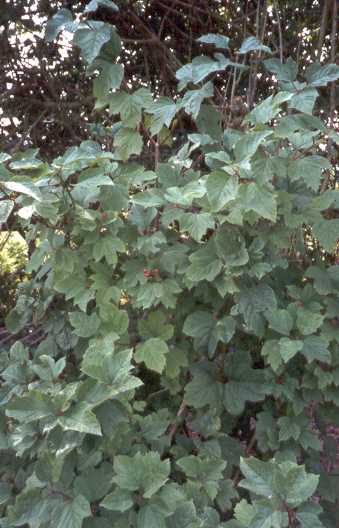
Description: Viburnum opulus is a shrub or small tree with nearly erect branches, found in hedgerows and woods over Europe and Russia and naturalised in North America. The large, broad, three to five-pointed leaves are on slender leafstalks, the small white flowers borne in dense cymes giving way to black or red globular drupes.
Parts used: stem bark
Collection: The stem bark is stripped before flowering.
Constituents: resin, a bitter (viburnin), valerianic acid, salicosides, tannin, saponins
Actions: spasmolytic, sedative, astringent, smooth and skeletal muscle relaxant, cardiac tonic, uterine relaxant, anti-inflammatory
Indications: cramp, ovarian and uterine pains, spasmodic muscular cramp, uterine dysfunction, menopausal metrorrhagia, threatened miscarriage, partus preparator, infantile enuresis.
 Therapeutics and Pharmacology: Viburnum
opulus is a specific
remedy for visceral tensions. It helps to relax muscular tension and spasm and
is primarily used in the treatment of muscular cramps and ovarian and uterine
muscle problems. It relaxes the uterus and relieves the painful cramps associated
with menstruation. It may also be used in threatened
miscarriage. Its astringent action gives it a role in the treatment of excessive
blood loss in periods and especially bleeding associated with the menopause. It may also be used to help quieten convulsive states in
children. It relaxes the cardiovascular system in hypertension and eases
constipation associated with tension. Applied externally, it relieves skeletal
muscle tension or cramps. It may also be helpful in some cases of migraine.
Therapeutics and Pharmacology: Viburnum
opulus is a specific
remedy for visceral tensions. It helps to relax muscular tension and spasm and
is primarily used in the treatment of muscular cramps and ovarian and uterine
muscle problems. It relaxes the uterus and relieves the painful cramps associated
with menstruation. It may also be used in threatened
miscarriage. Its astringent action gives it a role in the treatment of excessive
blood loss in periods and especially bleeding associated with the menopause. It may also be used to help quieten convulsive states in
children. It relaxes the cardiovascular system in hypertension and eases
constipation associated with tension. Applied externally, it relieves skeletal
muscle tension or cramps. It may also be helpful in some cases of migraine.
Combinations: This herb may be combined with Dioscorea and Zanthoxylum in cramp; and with Viburnum prunifolium and Chamaelirium or Valeriana in threatened miscarriage or uterine pains. It may be added to digestive remedies for irritable bowel, or combined with Juglans or Rheum palmatum for constipation caused by tension.
Preparation and Dosage: (thrice daily)
Dried bark: 2-4g or by decoction
Liquid extract: 1:1 in 25% alcohol, 2-4ml
Tincture: 1:5 in 45% alcohol, 5-10ml.
Additional Comments: Cramp bark was used by Native Americans for mumps and other swellings. The name Guelder comes from the Dutch province of Gueldersland, where the tree was first cultivated. The berries turn black on drying and have been used for making ink.
Bibliography
BHMA 1983 British Herbal Pharmacopoeia, BHMA, Bournemouth.
Grieve, M. 1931 A Modern Herbal, (ed. C.F. Leyel 1985), London.
Hoffmann, D. 1990 The New Holistic Herbal, Second Edition, Element, Shaftesbury.
Mills, S.Y. 1993 The A-Z of Modern Herbalism, Diamond Books, London.
Ody, P. 1993 The Herb Society's Complete Medicinal Herbal, Dorling Kindersley, London.