










Gentiana lutea (L)
Synonyms: bitter root, bitterwort, gentian
root, pale gentian, yellow gentian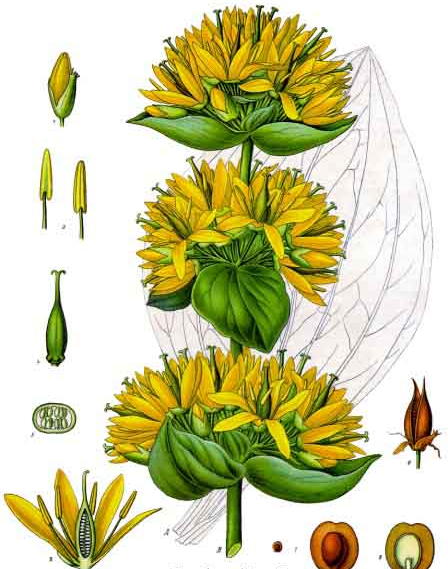
Order: Gentianaceae
Description: Gentiana is a perennial herb indigenous to the alpine and sub-alpine pastures of central and southern Europe. Ringed and forked, the thick wrinkled root is brown on the outside and yellow on the inside. The simple, erect, glabrous stem grows to a height of 120cm, giving off opposite bluish-green elliptical leaves with prominent curved veins. Three to ten yellow flowers arise together in the axils of bowl-shaped bracts after the root is about ten years old. The fruit is an oblong, two-valved capsule.
Parts used: dried root and rhizome
Collection: The root and rhizome are unearthed in late summer and autumn in the second or third year, before the plant is mature enough to flower. They should be sliced and dried slowly, during which time the characteristic odour, colour and taste develop.
Constituents: bitter principles of secoiridoid types (gentiopicrin, amarogentin, sweroside, swertiamarin); alkaloids (gentianine, gentialutine); oligosaccharides (gentianose); triterpenes; sugars (gentianose, gentiobiose), sucrose; polysaccharides (inulin, pectin); xanthones (gentisin, gentisein, isogentisin, gentioside, which impart the yellow colour to the root); phenolic acids (gentisic, caffeic, protocatechuic and others); traces of a complex volatile oil.
Actions: pronounced bitter gastric stimulant, sialagogue, cholagogue, tonic, antemetic, anti-inflammatory, febrifuge, refrigerant
Indications: anorexia, lack of appetite, atonic dyspepsia, gastrointestinal atony.
Therapeutics and Pharmacology: Gentiana is a much-used gastric stimulant, specifically indicated in dyspepsia with anorexia, but useful to digestive atony of any sort. It may be used in the treatment of insufficient gastric secretions, intestinal and gastric inflammations, hepatic and gallbladder disease, and is a useful adjunct to fever management and in conditions of chronic inflammatory disease where digestion appears to be less than ideal. Its action begins as soon as it is absorbed by the mucous membrane of the mouth. The secoiridoid bitter principles, particularly amarogentin, stimulate gustatory receptors in the taste buds, causing a reflex increase in the secretion of saliva, gastric juice and bile, thereby stimulating the appetite. Amarogentin is one of the most bitter substances known. It also accelerates emptying of the stomach and improves gastric tone, so that heavy food is more easily digested. Gentiana contains no tannin, so there is no astringent or irritant effect. One of its alkaloids, gentianine, has been shown to be anti-inflammatory. The fresh leaves placed on wounds and inflammations act as a refrigerant; and they also make soothing footbaths.
Combinations: Gentiana combines well with Zingiber, Elettaria and Rheum palmatum.
Caution: Caution is indicated with a sensitive, irritable stomach where there is excess acid because Gentiana can aggravate the symptoms of hyperacidity. It should not be used in cases of gastric or duodenal ulcers.
Preparation and Dosage: (thrice daily)
Regulatory Status: GSL Schedule 1
To be taken about an hour before meals
Dried rhizome and root: 0.6-2g or by infusion or decoction
Tincture: 1:5 in 45% alcohol, 1-4ml
Additional Comments: Gentian is named after Gentius, King of Illyria in the 1st century BC, who is said to have discovered the plant's ability to reduce fevers. Gentian root is used in many bitter liqueurs. Other species of Gentiana, known as longdan, are prescribed in Chinese medicine for similar conditions to those outlined above, as well as for conjunctivitis, urinary tract infections, jaundice, hepatitis, eczema and other skin problems
Bibliography
BHMA 1983 British Herbal Pharmacopoeia, BHMA, Bournemouth.
Bradley, P.R. (ed.) 1992 British Herbal Compendium, Volume 1, BHMA, Bournemouth.
Grieve, M. 1931 A Modern Herbal, (ed. C.F. Leyel 1985), London.
Hoffmann, D. 1990 The New Holistic Herbal, Second Edition, Element, Shaftesbury.
Lust, J. 1990 The Herb Book, Bantam, London.
Mabey, R. (ed.) 1991 The Complete New Herbal, Penguin, London.
Mills, S.Y. 1993 The Essential Book of Herbal Medicine, Penguin, London (First published in 1991 as Out of the Earth, Arkana)
Mills, S.Y. 1993 The A-Z of Modern Herbalism, Diamond Books, London.
Ody, P. 1993 The Herb Society's Complete Medicinal Herbal, Dorling Kindersley, London.
Polunin, M. and Robbins, C. 1992 The Natural Pharmacy, Dorling Kindersley, London.
Weiss, R.F. 1991 Herbal Medicine, Beaconsfield Arcanum, Beaconsfield.
Wren, R.C. 1988 Potter's New Cyclopaedia of Botanical Drugs and Preparations, C.W.Daniel, Saffron Walden.