










Scrophularia nodosa (L)
 Synonyms: figwort root, heal-all,
knotty-rooted figwort, kernelwort, scrofula plant, carpenter's square, rosenoble,
throatwort, knotted figwort
Synonyms: figwort root, heal-all,
knotty-rooted figwort, kernelwort, scrofula plant, carpenter's square, rosenoble,
throatwort, knotted figwort
Order: Scrophulariaceae
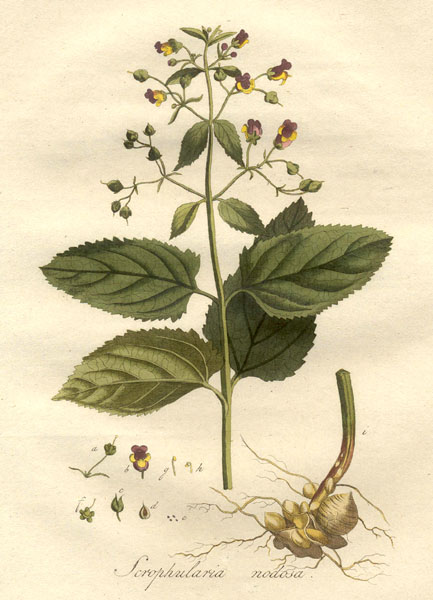
Description: Scrophularia is a coarse erect perennial with thick, sharply square, fleshy stems. Growing up to 150cm tall, it arises from a knotted horizontal rootstock. The leaves are opposite, short-stemmed ovate at base, lanceolate near the top, with toothed margins. The flowers are in loose cymes in pyramidal or oblong panicles; each flower is globular, five green sepals encircling a green or purple flower, giving way to an egg-shaped seed capsule. It grows in moist and cultivated waste ground, in woodlands and copses throughout the northern hemisphere except western North America.
Parts used: aerial parts
Collection: during flowering between June and August.
Constituents: saponins, hesperetin, cardioactive glycosides, anti-inflammatory glycosides, alkaloids, flavonoids, iridoids (including aucubine), resin, sugar, organic acids
Actions: Dermatological agent, alterative with circulatory stimulating properties, anti-inflammatory, mild diuretic, laxative, mild purgative, heart stimulant (increases myocardial contraction), circulatory stimulant.
Indications: eczema, psoriasis, pruritis
Therapeutics and Pharmacology: Scrophularia, as its name suggests, is a remedy used primarily in the treatment of skin problems such as eczema, psoriasis, pruritis and any skin condition where there is itching, discharge and irritation. Its purgative and diuretic actions enhance the cleansing effect. It may also be used as a mild laxative in constipation; aucubine has a laxative action and has been shown to stimulate the excretion of uric acid from the kidneys in animals. It is used in chronic inflammatory conditions, especially when marked by swollen lymph nodes; it is believed to stimulate the lymphatic system. It can also be made into an ointment for use on scratches, bruises and minor wounds. The bruised, fresh leaves can be applied to burns and swellings.
Combinations: Scrophularia combines with Rumex and Arctium in the treatment of skin problems.
Caution: As a heart stimulant, it should be avoided where there is an abnormally rapid heartbeat (tachycardia).
Preparation and Dosage: (thrice daily)
Regulatory Status: GSL
Dried herb: 2-8g by infusion
Liquid Extract: 1:1 in 25% alcohol, 2-8ml
Tincture: 1:10 in 45% alcohol, 2-4ml
Additional Comments: The Romans used Figwort to treat piles and, as its name implies, Scrophularia was once used to treat the 'King's Evil' or scrofula (tuberculosis of the cervical lymph nodes), purulent wounds and abscesses. Culpeper calls the herb throatwort because of its use in treating scrofula. The Chinese use xuan shen, the root of a related species, S. ningpoensis, as a remedy for 'fire poisons', the kind of purulent conditions associated with the herb in the West.
Bibliography
BHMA 1983 British Herbal Pharmacopoeia, BHMA, Bournemouth.
Culpeper, N. 1649 Complete Herbal and English Physician, 1990 reprint of the 1814 London edition of Culpeper�s Complete Herbal, Meyer, Illinois.
Grieve, M. 1931 A Modern Herbal, (ed. C.F. Leyel 1985), London.
Hoffmann, D. 1990 The New Holistic Herbal, Second Edition, Element, Shaftesbury.
Lust, J. 1990 The Herb Book, Bantam, London.
Mabey, R. (ed.) 1991 The Complete New Herbal, Penguin, London.
Mills, S.Y. 1993 The A-Z of Modern Herbalism, Diamond Books, London.
Ody, P. 1993 The Herb Society's Complete Medicinal Herbal, Dorling Kindersley, London.
Polunin, M. and Robbins, C. 1992 The Natural Pharmacy, Dorling Kindersley, London.
Wren, R.C. 1988 Potter's New Cyclopaedia of Botanical Drugs and Preparations, C.W.Daniel, Saffron Walden.