










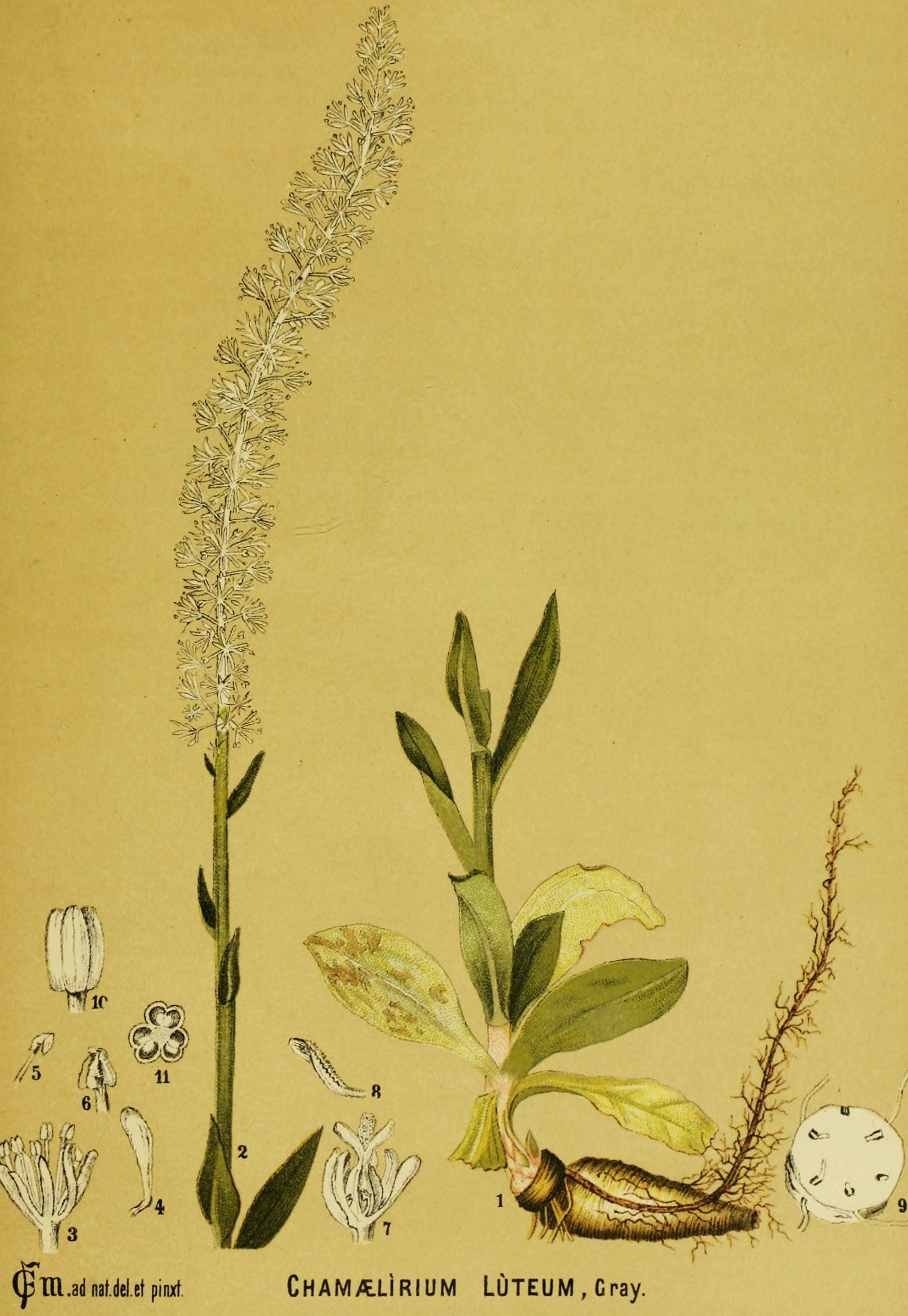
Chamaelirium luteum (L)
 Synonyms: Helionas dioica (Pursh.), Helonias lutea (Ker-Gawl),
Veratrum luteum (L.), Chamaelirium carolinianum (Willd.), helionas
root, blazing star root, devil's bit, starwort
Synonyms: Helionas dioica (Pursh.), Helonias lutea (Ker-Gawl),
Veratrum luteum (L.), Chamaelirium carolinianum (Willd.), helionas
root, blazing star root, devil's bit, starwort
Order: Liliaceae
Description: Chamaelirium is an herbaceous perennial, native to North America east of the Mississippi, is 30-100cm high, and has a smooth, angular stem and alternate leaves which are spatulate below, lanceolate above, 20cm by 2cm, narrow at the base and formed into a whorl. There are numerous small greenish-white flowers in a dense terminal raceme. The bulbous rhizome terminates abruptly and gives off fine wiry pale roots. The plant prefers low moist ground.
Parts used: Dried rhizome and roots
Collection: In September, after flowering
Constituents: steroidal saponins (including chamaelirin, a glycoside of diosgenin), helonin (a glycoside), free diosgenin, starch, calcium oxalate
Actions: uterine tonic, emmenagogue, ovarian adaptogenic, diuretic, emetic, anthelmintic
Indications: Specifically indicated in amenorrhoea and also used in ovarian dysmenorrhoea, menopausal complaints, leucorrhoea, the vomiting of pregnancy and threatened miscarriage due to atony of the uterus.
Therapeutics and Pharmacology: This herb is a valuable tonic to the reproductive system. It improves the secretory responses and cyclical functions of the ovary and appears to have an adaptogenic action on that organ. The steroidal saponins, precursors of the oestrogens, may account in part for this herb's reputation as an ovarian and uterine tonic. It acts in an amphoteric way to normalise function. Chamaelirium is of value in the treatment of amenorrhoea, dysmenorrhoea, irregular menstruation, vaginal discharge, pelvic congestion and structural laxity of the pelvic organs. It is of particular benefit in chronic pelvic inflammation such as chronic salpingitis, and for the hormonal adjustment problems that are a part of the menopause. It was traditionally used to prevent miscarriage and has a reputation for improving fertility caused by dysfunction in follicular formation. It can be effective against morning sickness, although large doses actually cause vomiting. Whilst primarily used in the treatment of the female reproductive system, Chamaelirium can be equally beneficial for men, and is useful in the treatment of impotence. Its tonic properties are of benefit to the appetite and digestion, and it also kills and helps expel worms.
Combinations: Chamaelirium combines well with Echinacea in chronic pelvic inflammation.
Caution: Very large doses may cause nausea and vomiting
Preparation and Dosage: (thrice daily)
Regulatory Status: GSL Schedule 2
Dried rhizome and roots: 1-2g or by infusion or decoction
Liquid Extract: 1:1 in 45% alcohol, 1-2ml
Tincture 1:5 in 45% alcohol, 2-5ml
Additional Comments: This plant is sometimes confused with Aletris farinosa, or true unicorn root, also called blazing star. Aletris also contains steroidal saponins (diosgenin) and is reported to have oestrogenic properties. The Native Americans used false unicorn root for disorders of the female reproductive organs.
Bibliography
Bradley, P.R. (ed.) 1992 British Herbal Compendium, Volume 1, BHMA, Bournemouth.
BHMA 1983 British Herbal Pharmacopoeia, BHMA, Bournemouth.
Grieve, M. 1931 A Modern Herbal, (ed. C.F. Leyel 1985), London.
Hoffmann, D. 1990 The New Holistic Herbal, Second Edition, Element, Shaftesbury.
Mabey, R. (ed.) 1991 The Complete New Herbal, Penguin, London.
Mills, S.Y. 1993 The Essential Book of Herbal Medicine, Penguin, London (First published in 1991 as Out of the Earth, Arkana)
Mills, S.Y. 1993 The A-Z of Modern Herbalism, Diamond Books, London.
Polunin, M. and Robbins, C. 1992 The Natural Pharmacy, Dorling Kindersley, London.
Wren, R.C. 1988 Potter's New Cyclopaedia of Botanical Drugs and Preparations, C.W.Daniel, Saffron Walden.