










Triticum repens (L)
Synonyms: Agropyron repens (Beauvais),
Rhizoma tritici, Radix graminis, dogs grass, twitchgrass, twitch,
triticum, scutch, witchgrass, quick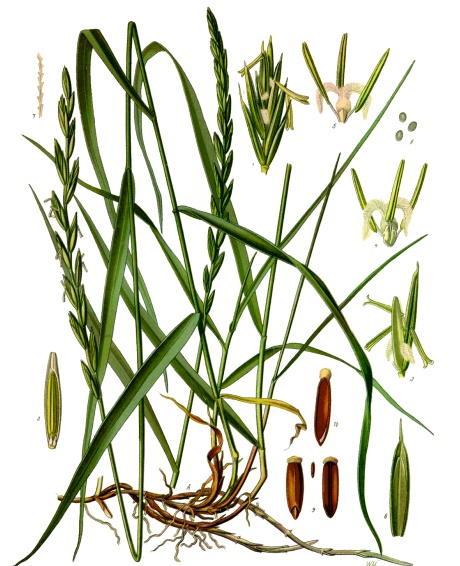 grass, quack grass, cutch, Scotch quelch, durfa grass
Order: Graminaceae
Description: Triticum is a pervasive perennial grass growing up to 1.5m in height and found in Europe, Northern Asia, Australia and America.
Parts used: Rhizome
Collection: The rhizome should be unearthed in spring or early autumn.
Constituents: 8% triticin (carbohydrate), mannitol, mucilage (triticin), silicic acid, potassium, inositol, mannitol, glycosides (including glucovanilline), gum, vanillin, saponin, an antimicrobial substance (agropyrene), iron and other minerals.
Actions: soothing mild diuretic, demulcent, antimicrobial, aperient, anticholesterolaemic
Indications: cystitis, urethritis, prostatitis, benign prostatic hypertrophy, renal calculus, lithuria.
Therapeutics and Pharmacology: Triticum is a useful remedy in the treatment of urinary infections such as cystitis, urethritis and prostatitis. Its demulcent properties soothe irritation and inflammation. It is also of value in the treatment of prostatitis, and may be used in kidney stones and gravel. Its has a healing action on the urinary mucosa, and is particularly effective for children's conditions and for helping to manage examples of tension in the urinary system such as enuresis and nervous incontinence. As a tonic diuretic, Triticum has been used with other herbs in the treatment of rheumatism.
The sugar mannitol present in large quantities in this herb, and is known as a standard 'osmotic diuretic', that is, it is absorbed whole from the gut and excreted largely by the kidney tubules. Its presence in the tubules means that extra water has to be retained in order to maintain osmotic pressure. The saponins and vanillin, also have diuretic properties. Silica, present as 30% of the inorganic residue, justifies this herb's use in the treatment of slow-healing wounds and to strengthen the lungs and other tissues. The antibiotic substance help to limit infections in the urinary tubules and elsewhere.
Combinations: For cystitis, urethritis and prostatitis Triticum may be combined with Barosma, Arctostaphylos or Achillea. It can be combined with Hydrangea for prostate problems.
Caution: No side-effects have so far been reported.
Preparation and Dosage: (thrice daily)
Regulatory status GSL
Dried rhizome: 4-8g or in decoction
Liquid extract: 1:1 in 25% alcohol, 4-8ml
Tincture: 1:5 in 40% alcohol, 5-15ml
Additional Comments: Couchgrass roots have been used as a medicine since the time of Dioscorides in the first century, and even sick dogs eat the leaves to produce a healing vomit. In Europe, it is still used as a tisane. Gerard wrote of Couchgrass '...it openeth the stoppings of the liver and reins without any manifest heat...', and Culpeper also praises its virtues for diseases of the kidneys.
Bibliography
BHMA 1983 British Herbal Pharmacopoeia, BHMA, Bournemouth.
Culpeper, N. 1649 Complete Herbal and English Physician, 1990 reprint of the 1814 London edition of Culpeper�s Complete Herbal, Meyer, Illinois.
Gerard, J. 1633 The Herball or Generall Historie of Plantes, Facsimile Edition (1975), Dover Publications, New York.
Grieve, M. 1931 A Modern Herbal, (ed. C.F. Leyel 1985), London.
Hoffmann, D. 1990 The New Holistic Herbal, Second Edition, Element, Shaftesbury.
Lust, J. 1990 The Herb Book, Bantam, London.
Mabey, R. (ed.) 1991 The Complete New Herbal, Penguin, London.
Mills, S.Y. 1993 The Essential Book of Herbal Medicine, Penguin, London (First published in 1991 as Out of the Earth, Arkana)
Mills, S.Y. 1993 The A-Z of Modern Herbalism, Diamond Books, London.
Polunin, M. and Robbins, C. 1992 The Natural Pharmacy, Dorling Kindersley, London.
Weiss, R.F. 1991 Herbal Medicine, Beaconsfield Arcanum, Beaconsfield.
Wren, R.C. 1988 Potter's New Cyclopaedia of Botanical Drugs and Preparations, C.W.Daniel, Saffron Walden.