










Symphytum officinale (L)
Synonyms and Common names: Symphyti radix/herba, Common comfrey, Knitbone, Boneset, consolida, consormol, consound, Blackwort, Bruisewort, gum plant, healing herb, knitback, salsify, slippery root, wallwort, Yalluc (Saxon), ass ear, nipbone
German = Reinweld, French = Grande consoude, Italian = Consolide maggiore
Order: Boraginaceae
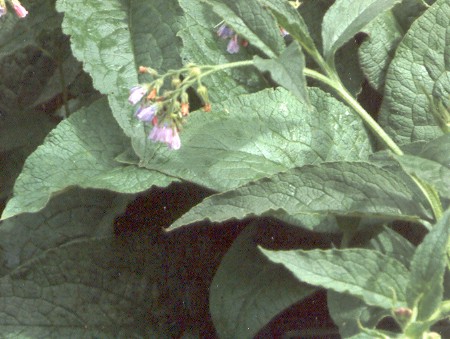
Description: Symphytum is an erect perennial growing in most damp areas of the United Kingdom, Europe, western Asia and the U.S.A. It is a vigorous plant with broadly lanceolate leaves up to 30cm long, which taper into a point. The leaves arise as a rosette from the ground, have a rough texture, and are covered with short stiff hairs. The rosette supports a tall, erect flowering stem up to 1.5m tall, covered with sessile opposite leaves and bearing forked stalks which support one-sided racemes of pedicillate bell-shaped mauve or white flowers which curve downwards. The fruits are four greyish-brown nutlets. The rhizome is quite short and thick with black, finger-thick branched roots. The flowering period is from May to July. Russian comfrey (S. peregrinum), widely grown for its horticultural benefits, can also be used medicinally.
Parts used: Root and rhizome, leaf
Collection: The roots should be unearthed in the spring or autumn when the allantoin levels are highest, then washed, chopped and dried at a moderate temperature. The leaves are harvested after flowering in early summer.
Constituents: Leaf - Mucilage, tannin, allantoin, symphytine, echinidine, Vitamin B12. Root - Allantoin (0.6-4.7%), about 29% mucilage (polysaccharides of fructose and glucose), phytosterols, triterpenoid (isobauerenol), phenolic compounds (including caffeic, chlorogenic and lithospermic acids), tannin, asparagine, pyrrolizidine alkaloids (including symphytine, cynoglossine, consolidine), inulin, resin, gum, starch.
Actions: Leaf - Vulnerary, demulcent, antihaemorrhagic, antirheumatic, anti-inflammatory. Root - Vulnerary, demulcent, cell proliferant, astringent, antihaemorrhagic, expectorant. Symphytum is an effective stimulant to fibroblast, chondroblast and osteoblast activity.
Indications: Leaf - Gastric and duodenal ulcer, rheumatic pain, arthritis. Topically as a poultice or fomentation in bruises, sprains, athlete's foot, crural ulcers and mastitis. Specifically indicated in gastric ulceration, and topically for varicose ulcers. Root - Gastric and duodenal ulcers, haematemesis, colitis; topically for ulcers, wounds, fractures and herniae by application of the fresh root preparation. Specifically indicated in gastric ulcer and topically for chronic varicose ulcer.
Therapeutics and Pharmacology: The impressive wound-healing properties of
Symphytum are partially due to the presence of allantoin which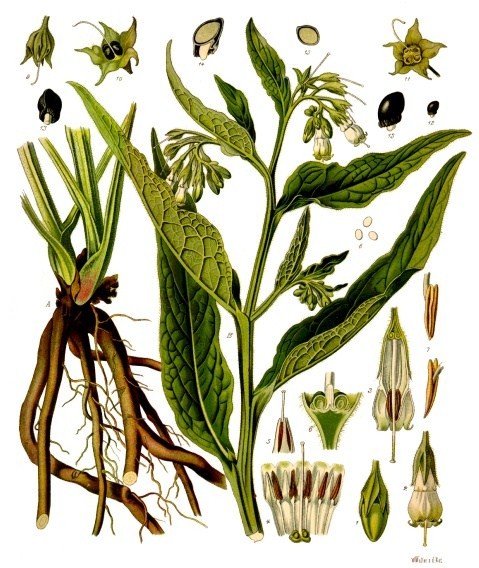 stimulates cell
proliferation, thereby accelerating wound-healing both internally and
externally. In superficial wounds this acceleration of the healing process can
prevent scar formation, but one must take care when dealing with infected wounds
to ensure that the infection is addressed first. Allantoin is able to diffuse
through the skin and tissues, hence its traditional use as an external
application for the treatment of bone fractures. On the surface of the skin its
action is aided by the contracting 'plaster' effect of the mucilage, tannins and
resins as they dry. Symphytum is an excellent remedy in the treatment of chronic
and varicose ulcers, and it has been used topically with some success in the
treatment of psoriasis (allantoin promotes keratin dispersal).
stimulates cell
proliferation, thereby accelerating wound-healing both internally and
externally. In superficial wounds this acceleration of the healing process can
prevent scar formation, but one must take care when dealing with infected wounds
to ensure that the infection is addressed first. Allantoin is able to diffuse
through the skin and tissues, hence its traditional use as an external
application for the treatment of bone fractures. On the surface of the skin its
action is aided by the contracting 'plaster' effect of the mucilage, tannins and
resins as they dry. Symphytum is an excellent remedy in the treatment of chronic
and varicose ulcers, and it has been used topically with some success in the
treatment of psoriasis (allantoin promotes keratin dispersal).
Allantoin is also effective when taken internally as it absorbed directly from the gut, so is of use in gastrointestinal disorders. In addition, Symphytum is rich in demulcent mucilage which augments allantoin�s powerful healing action in gastric and duodenal ulcers, hiatus hernia and ulcerative colitis. The aqueous extract of the plant increases the release of prostaglandins of the F series from the stomach wall, pointing to a direct action in protecting the gastric mucosa from damage. An Italian study has demonstrated significant anti-inflammatory activity in vivo. Symphytum�s astringency, due to its tannin content, will help arrest bleeding wherever it occurs. The mucilage also ensures Symphytum's usefulness as a bulk laxative and as a soothing remedy for the lower gut, and this may in turn operate by reflex to account for its usefulness in excessive menstrual bleeding, haematuria, and urinary spasm.
Symphytum has been used with success in cases of bronchitis and irritable cough, where it soothes and reduces irritation whilst helping expectoration. It also has a reputed anti-cancer action.
Combinations: For gastric ulcers and inflammations Symphytum combines well with Althaea and Filipendula. For chest and bronchial troubles it can be used with Tussilago, Marrubium or Inula. The root may be combined with Althaea for topical external application as an ointment. For a poultice, the powdered leaf may be combined with Ulmus and Linum. For the topical treatment of a sprain, it combines well with Jacobaea and Sambucus leaf.
Caution: Care should be taken with very deep wounds as the external application of Symphytum can lead to tissue forming over the wound before it has healed deeper down, leading to the possibility of an abscess. Internal consumption of the root should be avoided because of the pyrrolizidine alkaloids, which have been linked by some research to liver cancer in rats (on the other hand, there is data to demonstrate that the whole plant actually has a protective effect against liver poisoning, disease and tumours in experimental animals). Hepatic veno-occlusive disease has been related to Symphytum ingestion at high doses over long periods, and the effects of the alkaloids are cumulative. Topical application is safer and more effective for arthritis than internal administration. External application need not be restricted.
Preparation and Dosage: (thrice daily)
Leaf: GSL Schedule 1
Dried leaf: 2-8g or by infusion
Liquid Extract Leaf: 1:1 in 25% alcohol, 2-8ml
Root: GSL Schedule 2 - restricted to external use
Dried root or rhizome: 2-4g in decoction
Liquid Extract Root: 1:1 in 25% alcohol, 2-4ml
Ointment Root: 10-15% extractive in ointment base
Additional Comments: In the past, comfrey baths were popular before marriage to repair the hymen and thus 'restore virginity'. Gerard wrote in 1597 that Comfrey should be '...given to drinke against the paine of the backe, gotten by violent motion as wrestling or overmuch use of women...). A plant high in protein (up to 35%), comfrey is used as an animal feed and organic manure as well as a medicine. The name knitbone derives from its useful property of healing broken bones and wounds; it has even been used by orthopaedic surgeons on complicated bone fractures. This property has been known at least since Roman times, when it was named conferva, meaning to join together. Recently there has been concern that the pyrrolizidine alkaloids contained in comfrey may damage the liver; however, this has been shown only with high doses of plant extracts and not with normal therapeutic doses of the whole herb.
The fresh leaves and shoots may be cooked as a vegetable or eaten raw in a salad. One of the minerals which has been extracted from comfrey is cobalt, which it uses to produce possibly the only plant source of vitamin B12, making it a valuable dietary supplement for vegans. For the gardener, Symphytum makes an excellent green compost.
Bibliography
Bartram, T. 1995 Encyclopedia of Herbal Medicine, 1st edn.,Grace Publishers, Bournemouth.
Bradley, P.R. (ed.) 1992 British Herbal Compendium, Volume 1, BHMA, Bournemouth.
Bremness, L. 1994 Herbs, Dorling Kindersley Eyewitness Handbook, London.
BHMA 1983 British Herbal Pharmacopoeia, BHMA, Bournemouth.
Cao Y, Colegate SM, Edgar JA. 2008 Safety assessment of food and herbal products containing hepatotoxic pyrrolizidine alkaloids: interlaboratory consistency and the importance of N-oxide determination. Phytochem Anal. 2008 Nov; 19 (6) :526-33. PubMed PMID:18618436.
Chevallier, A. 1996 The Encyclopedia of Medicinal Plants, Dorling Kindersley, London.
D'Anchise R, Bulitta M, Giannetti B. 2007 Comfrey extract ointment in comparison to diclofenac gel in the treatment of acute unilateral ankle sprains (distortions). Arzneimittelforschung. 2007; 57 (11) :712-6. PubMed PMID:18193693.
Giannetti BM, Staiger C, Bulitta M, Predel HG. 2010 Efficacy and safety of comfrey root extract ointment in the treatment of acute upper or lower back pain: results of a double-blind, randomised, placebo controlled, multicentre trial. Br J Sports Med. 2010 Jul; 44 (9) :637-41. PubMed PMID:19460762.
Gomes MF, de Oliveira Massoco C, Xavier JG, Bonamin LV. 2010 Comfrey (Symphytum Officinale l) and Experimental Hepatic Carcinogenesis: A Short-term Carcinogenesis Model Study. Evid Based Complement Alternat Med. 2010 Jun; 7 (2) :197-202. PubMed PMID:18955295; PubMed Central PMCID: PMC2862927.
Grieve, M. 1931 A Modern Herbal, (ed. C.F. Leyel 1985), London.
Grube B, Gr�nwald J, Krug L, Staiger C. 2007 Efficacy of a comfrey root (Symphyti offic radix) extract ointment in the treatment of patients with painful osteoarthritis of the knee: results of a double-blind, randomised, bicenter, placebo-controlled trial. Phytomedicine. 2007 Jan; 14 (1) :2-10. PubMed PMID:17169543.
Gy�rik S, Stricker H. 2009 Severe pulmonary hypertension possibly due to pyrrolizidine alkaloids in polyphytotherapy. Swiss Med Wkly. 2009 Apr 4; 139 (13-14) :210-1. PubMed PMID:19350428.
Hoffmann, D. 1990 The New Holistic Herbal, Second Edition, Element, Shaftesbury.
Hyperhealth 1996 Natural Health and Nutrition Databank, v.96.1 CD-ROM, �In-Tele-Health, available from Healthworks, Leeds. ISBN 0-646-30942-0
Koll R, Buhr M, Dieter R, Pabst H, Predel HG, Petrowicz O, Giannetti B, Klingenburg S, Staiger C. 2004 Efficacy and tolerance of a comfrey root extract (Extr Rad Symphyti) in the treatment of ankle distorsions: results of a multicenter, randomized, placebo-controlled, double-blind study. Phytomedicine. 2004 Sep; 11 (6) :470-7. PubMed PMID:15500257.
Kucera M, Barna M, Hor�cek O, Kov�rikov� J, Kucera A. 2004 Efficacy and safety of topically applied Symphytum herb extract cream in the treatment of ankle distortion: results of a randomized controlled clinical double blind study. Wien Med Wochenschr. 2004 Nov; 154 (21-22) :498-507. PubMed PMID:15638067.
Kucera M, Barna M, Hor�cek O, K�lal J, Kucera A, Hlad�kova M. 2005 Topical symphytum herb concentrate cream against myalgia: a randomized controlled double-blind clinical study. Adv Ther. 2005 Nov-Dec; 22 (6) :681-92. PubMed PMID:16510384.
Lust, J. 1990 The Herb Book, Bantam, London.
Mabey, R. (ed.) 1991 The Complete New Herbal, Penguin, London.
Mei N, Guo L, Fu PP, Fuscoe JC, Luan Y, Chen T. 2010 Metabolism, genotoxicity, and carcinogenicity of comfrey. J Toxicol Environ Health B Crit Rev. 2010 Oct; 13 (7-8) :509-26. PubMed PMID:21170807
Mei N, Guo L, Fu PP, Heflich RH, Chen T. 2005 Mutagenicity of comfrey (Symphytum Officinale) in rat liver. Br J Cancer. 2005 Mar 14; 92 (5) :873-5. PubMed PMID:15726100; PubMed Central PMCID: PMC2361893.
Mills, S.Y. 1993 The Essential Book of Herbal Medicine, Penguin, London (First published in 1991 as Out of the Earth, Arkana)
Mills, S.Y. 1993 The A-Z of Modern Herbalism, Diamond Books, London.
Newall, C.A., Anderson, L.A., & Phillipson, J.D. 1996 Herbal Medicines: A Guide for Health-care Professionals, The Pharmaceutical Press, London.
Ody, P. 1993 The Herb Society's Complete Medicinal Herbal, Dorling Kindersley, London.
Polunin, M. and Robbins, C. 1992 The Natural Pharmacy, Dorling Kindersley, London.
Predel HG, Giannetti B, Koll R, Bulitta M, Staiger C. 2005 Efficacy of a comfrey root extract ointment in comparison to a diclofenac gel in the treatment of ankle distortions: results of an observer-blind, randomized, multicenter study. Phytomedicine. 2005 Nov; 12 (10) :707-14. PubMed PMID:16323288.
Prihoda, A. 1989 The Healing Powers of Nature, Octopus, London.
Rogers, S.K. 1995 British and Chinese Herbal Pharmacopoeia, Healthlink Software Systems, Australia
Stickel F, Seitz HK. 2000 The efficacy and safety of comfrey. Public Health Nutr. 2000 Dec; 3 (4A) :501-8. PubMed PMID:11276298.
Weiss, R.F. 1991 Herbal Medicine, Beaconsfield Arcanum, Beaconsfield.
Wren, R.C. 1988 Potter's New Cyclopaedia of Botanical Drugs and Preparations, C.W.Daniel, Saffron Walden.
Yeong ML, Clark SP, Waring JM, Wilson RD, Wakefield SJ. 1991The effects of comfrey derived pyrrolizidine alkaloids on rat liver. Pathology. 1991 Jan; 23 (1) :35-8. PubMed PMID:2062566.