








Eugenia caryophyllus (Spreng.)
Order: Myrtaceae
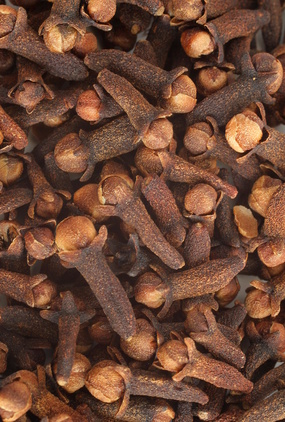 Part used: dried flower buds and oil
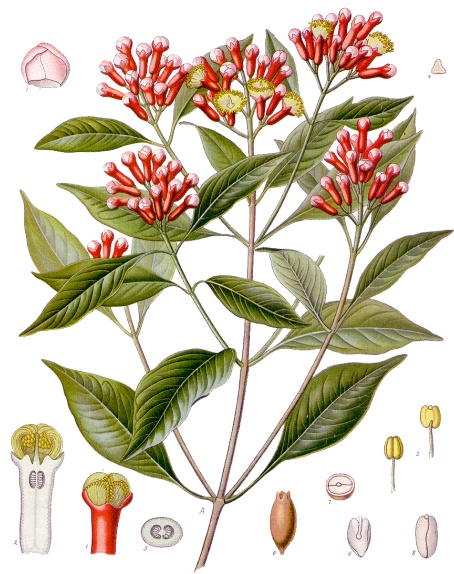
Description: an evergreen topical tree up to 30 feet tall, native to the Spice Islands and the Philippines but also grown in Sumatra, Jamaica, the West Indies, Brazil and other tropical areas. It has opposite, ovate leaves more than 12cm long and its flowers, when allowed to develop, are red and white, bell-shaped, and grow in terminal clusters. The fruit is a one or two-seeded berry.
Collection: the unopened flower buds are harvested from September to February by beating the branches of the tree; they are then dried in the sun, turning a deep brown. Each tree can yield up to 30kg of cloves.
Constituents: up to 20% volatile oil, gallotannic acid, crystalline principles (caryophyllin and eugenin), gum, resin, fibre.
Actions: stimulant, carminative, aromatic, anodyne, antiemetic, antiseptic.
Indications: nausea, vomiting and flatulence.
Therapeutics and Pharmacology: A few drops of the oil in water will stop vomiting and an infusion will relieve nausea. Eugenia is a powerful local antiseptic and mild anaesthetic which may be used topically in toothache. For toothache, put a clove near the tooth and keep in the mouth, or use clove oil on a little cotton wool.
Preparation and Dosage: (thrice daily)
Regulatory Status: GSL
Powder 120-300mg; Clove oil 0.05-0.2ml
Additional Comments: The first recorded use of cloves is by the Chinese in the first century BC - Emperors of the Han Dynasty expected people to approach them with a clove in their mouth to ensure that their breath was sweet. Cloves and clove oils are used in the preparation of certain types of cigarette, such as Indonesian Kretaks for their stimulant action. Oil of cloves is a common ingredient of mouthwashes and toothpastes. Stuck into an orange, cloves make a traditional pomander for keeping clothes smelling fresh and to repel moths. They are said to be aphrodisiac.
Bibliography
Grieve, M. 1931 A Modern Herbal, (ed. C.F. Leyel 1985), London.
Hoffmann, D. 1990 The New Holistic Herbal, Second Edition, Element, Shaftesbury.
Lust, J. 1990 The Herb Book, Bantam, London.
Richardson, R. 1988 The Little Spice Book, Piatkus, Loughton.
Wren, R.C. 1988 Potter's New Cyclopaedia of Botanical Drugs and Preparations, C.W.Daniel, Saffron Walden.