










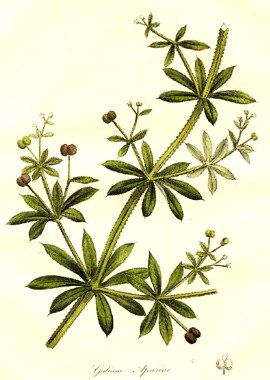
Galium aparine (L)
 Synonyms and common names: Galii aparinis herba, Clivers,
Goosegrass, Galium, Hedge burs, Sticky-willie, Cleaverwort, Coachweed. Gosling
weed, Love-man, Stick-a-back, Sweethearts, Hayruff, Hayriffe, Erriffe, Burweed,
Barweed, Goosebill, Hedgeheriffe, Grip grass, Catchweed, Catchgrass, Scratweed,
Mutton chops, Robin-run-in-the-grass, Everlasting friendship, Clike, Click,
Clitheren, Clithers.
Synonyms and common names: Galii aparinis herba, Clivers,
Goosegrass, Galium, Hedge burs, Sticky-willie, Cleaverwort, Coachweed. Gosling
weed, Love-man, Stick-a-back, Sweethearts, Hayruff, Hayriffe, Erriffe, Burweed,
Barweed, Goosebill, Hedgeheriffe, Grip grass, Catchweed, Catchgrass, Scratweed,
Mutton chops, Robin-run-in-the-grass, Everlasting friendship, Clike, Click,
Clitheren, Clithers.
French = Gratterton, German = Klebelabkraut, Spanish = Presera, Italian = Cappelo di tignosi
Order: Rubiaceae
Description: A native British straggling annual, up to 120cm tall, Galium clings to bushes and hedges and to any creature brushing by them, by tiny curved prickles on the angles of the stems and the veins and edges of the thin lanceolate leaves. The leaves, up to 3cm long, occur in whorls of 6-8 encircling the stem. Small greenish-white flowers are borne in peduncles from the axils of each whorl. The round two-lobed fruits form small burrs up to 6mm in diameter, covered with hooked bristles. Galium is a common hedgerow plant throughout Britain, Europe, Canada, and the eastern half and Pacific coast of the United States.
Parts used: Aerial parts and fresh juice
Collection: The plant is harvested from spring to early summer, before it becomes too fibrous.
Constituents: Iridoid glycosides (monotropein, asperuloside, aucubin), phenolic acids (caffeic, gallic), anthraquinone derivatives, flavonoids, coumarins, tannins, citric acid, red dye (including galiosin).
Actions: Mild diuretic, mild astringent, lymphatic alterative, anti-inflammatory, aperient, tonic, antineoplastic
Indications: Galium's alterative and diuretic actions make it an effective lymphatic tonic and it is used in the treatment of a wide range of problems involving the lymphatic system, including lymphadenitis, tonsillitis, glandular fever and enlarged adenoids. It is particularly useful in the treatment of toxic conditions associated with tissue oedema and water retention. There is a long tradition for the use of Galium in the treatment of ulcers and tumours, which may be due to lymphatic drainage. It is also used internally and topically to treat skin conditions, particularly dry conditions such as psoriasis. An infusion of the herb may be used as a hair rinse for dandruff or seborrhoea. It may also be applied to burns and abrasions.
Galium can be used to treat cystitis and other urinary conditions where there is pain, such as calculi, colic or strangury, where it is combined with demulcent herbs. The red dye galiosin is similar to the dye in Galium�s relative, Rubia tinctoria (madder); this has specific anti-inflammatory and spasmolytic effects on the urinary tract and may contribute to Rubia�s litholytic action in the urinary system (it stains the urine red). Galium is also reputed to help reduce blood pressure and to cool the body during fevers. The iridoid asperuloside is a mild laxative.
Combinations: Galium may be combined with Althaea in cystitis. For treatment of the lymphatic system, its action is augmented by Phytolacca, Echinacea and Calendula. For skin conditions it is best combined with Rumex and Arctium.
Caution: No contraindications are known. It has been stated that diabetics should take the fresh juice with caution, although this is not supported by pharmacological data.
Preparation and Dosage: (thrice daily)
GSL, Schedule 1
Dried herb: 2-4g or by infusion
Liquid Extract: 1:1 in 25% alcohol, 2-4ml
Tincture: 1:5 in 25% alcohol, 4-10ml
Expressed Juice: 5-15ml
Additional Comments: Gerard recommends Clivers as a marvellous remedy for the bites of snakes, spiders and all venomous creatures and, quoting Pliny, says: 'a pottage made of Clivers, a little mutton and oatmeal is good to cause lankness and keepe from fatnesse.' Culpeper recommended the herb for earache. Most of its popular names concern its clinging nature. The Anglo-Saxon 'hedgeherriff' means a tax gatherer or robber. The specific name of the plant, aparine, also refers to the plant's habit, being derived from the Greek aparo (to seize).
Clivers can be eaten as a vegetable, gently sweated in a pan like spinach. The juice is a popular spring tonic in Central Europe, the Balkans and elsewhere. In France, the crushed herb is applied as a poultice to sores and blisters. Geese are fond of this herb, also known as goosegrass, and it is often fed to poultry. The seeds can be roasted and used as a coffee substitute. Greek shepherds used the stems in the to make sieves for straining milk, and Linnaeus reported the same use being made of them in Sweden. The roots produce a red dye.
Bibliography
Bartram, T. 1995 Encyclopedia of Herbal Medicine, 1st edn.,Grace Publishers, Bournemouth.
Bradley, P.R. (ed.) 1992 British Herbal Compendium, Volume 1, BHMA, Bournemouth.
BHMA 1983 British Herbal Pharmacopoeia, BHMA, Bournemouth.
Chevallier, A. 1996 The Encyclopedia of Medicinal Plants, Dorling Kindersley, London.
Dyer, A. 1981 Dyes from Natural Sources, Bell & Hyman, London.
Grieve, M. 1931 A Modern Herbal, (ed. C.F. Leyel 1985), London.
Hoffmann, D. 1990 The New Holistic Herbal, Second Edition, Element, Shaftesbury.
Lust, J. 1990 The Herb Book, Bantam, London.
Mabey, R. (ed.) 1991 The Complete New Herbal, Penguin, London.
Mills, S.Y. 1993 The Essential Book of Herbal Medicine, Penguin, London (First published in 1991 as Out of the Earth, Arkana)
Mills, S.Y. 1993 The A-Z of Modern Herbalism, Diamond Books, London.
Newall, C.A., Anderson, L.A., & Phillipson, J.D. 1996 Herbal Medicines: A Guide for Health-care Professionals, The Pharmaceutical Press, London.
Ody, P. 1993 The Herb Society's Complete Medicinal Herbal, Dorling Kindersley, London.
Polunin, M. and Robbins, C. 1992 The Natural Pharmacy, Dorling Kindersley, London.
Vickery, R. 1995 A Dictionary of Plant Lore, Oxford University Press.
Wren, R.C. 1988 Potter's New Cyclopaedia of Botanical Drugs and Preparations, C.W.Daniel, Saffron Walden.