










Nepeta cataria (L)
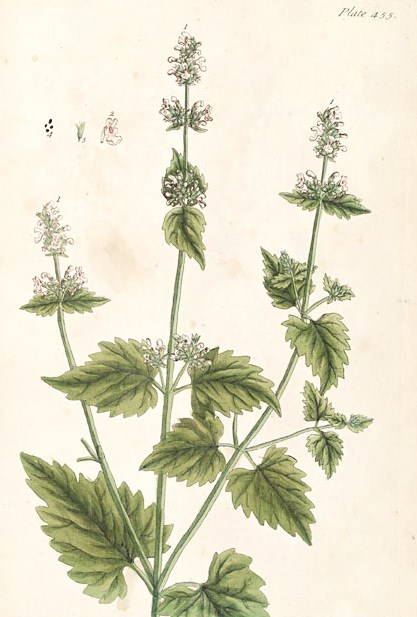 Synonyms and Common names: Catnip, Catnep,
Catrup, Catswort, Field balm
Synonyms and Common names: Catnip, Catnep,
Catrup, Catswort, Field balm
German = Katzenkraut, French = Cataire, Spanish = Nebeda, Italian = Cataria
Order: Labiatae
Description: An erect, shrubby herb, up to a metre tall, with whitish-green serrated ovate leaves with hairy undersides. The flowers are white to pale blue, with crimson dots, and are arranged in small tight whorls with toothed hairy sepals. The mint-like odour is much-loved by cats. It inhabits banks, waysides and waste places on calcareous soils throughout northern temperate regions.
Parts used: Leaves and flowering tops
Collection: Between June and September
Constituents: Volatile oil (including carvacrol, nepetol, thymol, nepetalactone, citronellol, geraniol and citral), bitter principle, tannins
Actions: Aromatic, carminative, spasmolytic, antispasmodic, diaphoretic, febrifuge, antidiarrhoeal, sedative, astringent, refrigerant, digestive stimulant, gentle circulatory stimulant (although it reduces body temperature in fever), antidiarrhoeal
Indications: Nervous dyspepsia, colic in children, colds, headache, insomnia. Topically as an ointment in haemorrhoids. Specifically indicated in flatulent colic in children, and in the treatment of the common cold.
Therapeutics and Pharmacology: Nepeta is a traditional remedy for colds and flu. A powerful diaphoretic in any feverish condition, it is particularly useful where there is a feeling of congestion in the airways, sinuses or middle ear. It is also a safe remedy for the infectious diseases of childhood, such as measles. Its mild sedative action will help a restless child to sleep. As an antispasmodic carminative, it relieves dyspepsia, flatulence and colic, and is an excellent remedy for the treatment of diarrhoea in children, where its sedative action adds to its generally relaxing properties. In the USA it has been used as an enema to cleanse and heal the lower bowel.
Combinations: Nepeta may be combined with Mentha piperata in children's colic, and with Yarrow, Sambucus, Capsicum and Eupatorium perfoliatum in the common cold.
Preparation and Dosage: (thrice daily)
Regulatory Status: GSL Schedule 1
Dried herb: 2-4g or by infusion
Liquid Extract: 1:1 in 25% alcohol, 2-4ml
Tincture: 1:5 in 25% alcohol, 3-6ml
Additional Comments: In France, the leaves and young shoots of catmint are used as a seasoning. Mrs. Grieve states that the young tops, made into a conserve, can be administered for nightmares. Culpeper recommended the juice of the plant drunk with wine for bruises, the bruised leaves for haemorrhoids, and a decoction used as a shampoo for scabs and scurf. Cats are attracted to Nepeta but rats hate it. The leaves give a mild euphoria when smoked.
Bibliography
Bartram, T. 1995 Encyclopedia of Herbal Medicine, 1st edn.,Grace Publishers, Bournemouth.
BHMA 1983 British Herbal Pharmacopoeia, BHMA, Bournemouth.
Bremness, L. 1994 Herbs, Dorling Kindersley Eyewitness Handbook, London.
Chevallier, A. 1996 The Encyclopedia of Medicinal Plants, Dorling Kindersley, London.
Grieve, M. 1931 A Modern Herbal, (ed. C.F. Leyel 1985), London.
Hoffmann, D. 1990 The New Holistic Herbal, Second Edition, Element, Shaftesbury.
Lust, J. 1990 The Herb Book, Bantam, London.
Mabey, R. (ed.) 1991 The Complete New Herbal, Penguin, London.
Mills, S.Y. 1993 The A-Z of Modern Herbalism, Diamond Books, London.
Ody, P. 1993 The Herb Society's Complete Medicinal Herbal, Dorling Kindersley, London.
Wren, R.C. 1988 Potter's New Cyclopaedia of Botanical Drugs and Preparations, C.W.Daniel, Saffron Walden.