









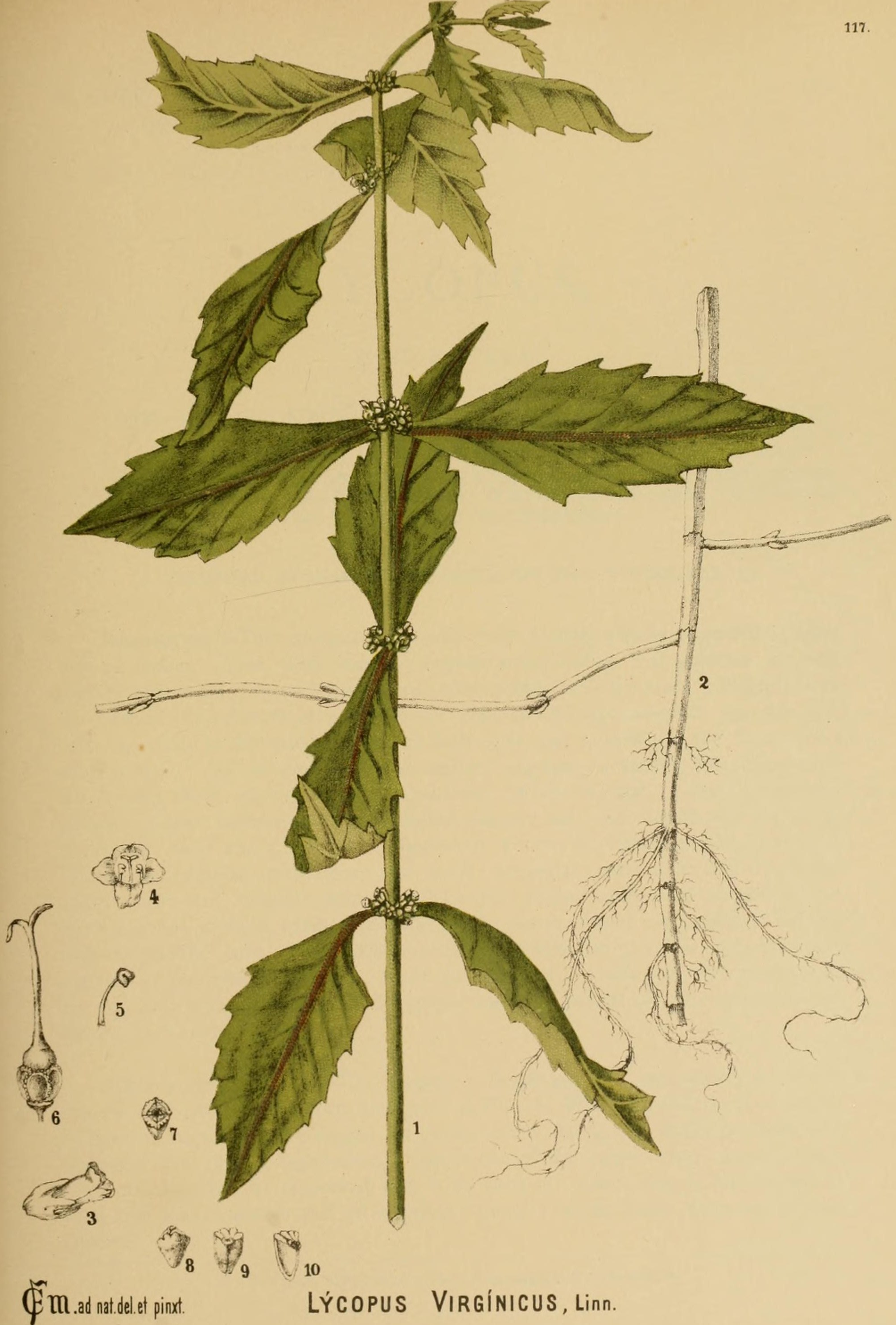
Lycopus virginicus/Lycopus europaeus (L)
 Synonyms: L.virginicus: sweet bugle,
water bugle, Virginian water horehound, gipseyweed, gypseywort; water horehound
Synonyms: L.virginicus: sweet bugle,
water bugle, Virginian water horehound, gipseyweed, gypseywort; water horehound
Order: Labiatae
Description: L. europaeus: Common throughout Europe by the banks of streams; an erect plant, somewhat hairy, usually with ascending branches, deeply toothed lanceolate leaves and purple-dotted white flowers of labiate type in close whorls in the axis of the upper leaves. Flowers from July to September. L. virginicus: Native to North America; leaves glabrous, elliptical lanceolate, toothed above but entire near the base. Stem quadrangular; flowers in axillary clusters with a purplish four-lobed corolla and only two fertile stamens.
Parts used: aerial parts
Collection: just before the buds open
Constituents: flavone glycosides, volatile oil, tannins
Actions: Sedative, astringent, thyrotropic, cardioactive diuretic, peripheral vasoconstrictor, antitussive, antihaemorrhagic (especially pulmonary haemorrhage)
Indications:
Therapeutics and Pharmacology: Recent research shows an anti-hormonal, particularly anti-thyrotropic, activity for this herb. It is used specifically in Grave's disease with cardiac involvement where the symptoms include tightness of breathing, palpitations and shaking. Lycopus extracts have been used empirically in the treatment of Graves disease, where a thyroid-stimulating antibody is found in the blood; this antibody has been shown to bind to and be inhibited by the plant extract. Its action is less powerful than that of synthetic drugs, but is usually adequate in less severe cases and safe for long-term treatment. It increases the force of myocardial contraction and reduces heart rate; it is indicated in nervous tachycardia. It will aid a weak heart where there is associated fluid retention. It is a useful sedative cough remedy, especially in irritating coughs and those of nervous origin, or where there is copious sputum. Lycopus was much used in the past for the treatment of consumption.
Combinations: Lycopus combines well with Sarothamnus and/or Convallaria in cardiac cases; and with Prunus, and/or Ascelpias for pulmonary conditions. It may also be combined with nervines such as Scutellaria or Valeriana.
Preparation and Dosage: (thrice daily)
Regulatory status GSL
Dried herb: 1-3g or by infusion
Liquid Extract: 1:1 in 25% alcohol, 1-3ml
Tincture: 1:5 in 45% alcohol, 2-6ml
Additional Comments: L. europaeus yields a black dye which was formerly used by gypsies to stain the skin.
Bibliography
BHMA 1983 British Herbal Pharmacopoeia, BHMA, Bournemouth.
Grieve, M. 1931 A Modern Herbal, (ed. C.F. Leyel 1985), London.
Hoffmann, D. 1990 The New Holistic Herbal, Second Edition, Element, Shaftesbury.
Weiss, R.F. 1991 Herbal Medicine, Beaconsfield Arcanum, Beaconsfield.
Wren, R.C. 1988 Potter's New Cyclopaedia of Botanical Drugs and Preparations, C.W.Daniel, Saffron Walden.