










Iris versicolor (L)
Synonyms: Flag lily, purple flag, fleur-de-lis, flower-de-luce, liver lily, poison flag, snake lily, water flag, wild iris, flag lily, dragon flower, dagger flower
Order: Iridaceae
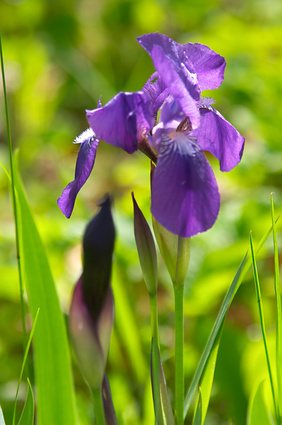 Description: Iris is a perennial herb with large
blue flowers with yellow and white markings at the base of the sepals. It grows in wetlands in eastern and central North America and is cultivated in many
other parts of the world. Its stout stem grows from a thick, cylindrical
creeping rootstock and bears two ranks of sword-shaped long, narrow leaves. Each
stem has two or three large blue or purplish flowers featuring three petal-like,
spreading or recurved sepals below and three petals, smaller than the sepals,
above.
Description: Iris is a perennial herb with large
blue flowers with yellow and white markings at the base of the sepals. It grows in wetlands in eastern and central North America and is cultivated in many
other parts of the world. Its stout stem grows from a thick, cylindrical
creeping rootstock and bears two ranks of sword-shaped long, narrow leaves. Each
stem has two or three large blue or purplish flowers featuring three petal-like,
spreading or recurved sepals below and three petals, smaller than the sepals,
above.
Parts used: Rhizome
Collection: The rhizome is best collected in autumn
Constituents: Acrid resin (irisin, isophthalic acid), volatile oil, starch, salicylates (including salicylic acid), alkaloid, tannin
Actions: Laxative, cholagogue, alterative, diuretic, dermatological agent, anti-inflammatory, circulatory and lymphatic stimulant; emetic (antemetic in small doses), cathartic.
Indications: skin diseases, biliousness with constipation and liver dysfunction
Therapeutics and Pharmacology: Iris is widely used in the treatment of skin problems, especially where these are associated with bowel and liver disturbances and / or congestive circulation. For more chronic skin problems such as eczema and psoriasis, it is valuable as part of a wider treatment. It is of benefit where there is constipation associated with liver problems or biliousness. It helps to relieves flatulence, heartburn, belching and nausea and may be used for headaches associated with digestive problems. It acts on the liver and gallbladder to increase the flow of bile. Externally, the bruised fresh leaves may be used for burns and sores.
Combinations: May be combined with Rumex, Trifolium, Phytolacca and Stillingia in skin disease.
Caution: The fresh root can cause nausea and vomiting; small doses of the dried root are advised. It may also cause dermatitis in sensitive individuals..
Preparation and Dosage: (thrice daily)
Regulatory Status: GSL
Dried rhizome: 0.6-2g or by decoction
Liquid Extract: 1:1 in 45% alcohol, 1-2ml
Additional Comments: Blue Flag was a common Native American remedy, and was once included in the United States Pharmacopoeia. It was used in the treatment of dropsy. In one recent study, Blue Flag was shown to reduce food intake in rats and it was claimed that this demonstrates anti-obesic properties.
Bibliography
Bradley, P.R. (ed.) 1992 British Herbal Compendium, Volume 1, BHMA, Bournemouth.
BHMA 1983 British Herbal Pharmacopoeia, BHMA, Bournemouth.
Grieve, M. 1931 A Modern Herbal, (ed. C.F. Leyel 1985), London.
Hoffmann, D. 1990 The New Holistic Herbal, Second Edition, Element, Shaftesbury.
Lust, J. 1990 The Herb Book, Bantam, London.
Mabey, R. (ed.) 1991 The Complete New Herbal, Penguin, London.
Mills, S.Y. 1993 The A-Z of Modern Herbalism, Diamond Books, London.
Ody, P. 1993 The Herb Society's Complete Medicinal Herbal, Dorling Kindersley, London.
Wren, R.C. 1988 Potter's New Cyclopaedia of Botanical Drugs and Preparations, C.W.Daniel, Saffron Walden.