






Polygonum bistorta (L)
 Synonyms: great bistort, adderwort, English
serpentary, snakeweed, snake root, dragonwort, osterick, oderwort, Easter mangiant,
twice writhen, patience dock, sweet dock, red legs
Synonyms: great bistort, adderwort, English
serpentary, snakeweed, snake root, dragonwort, osterick, oderwort, Easter mangiant,
twice writhen, patience dock, sweet dock, red legs
Order: Polygonaceae
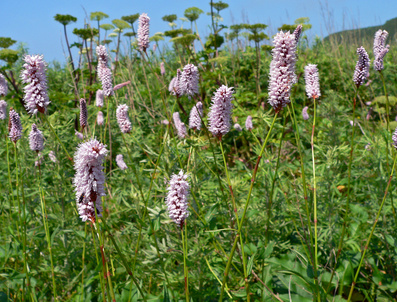
Description: This tall perennial herb grows in moist, shady areas on higher ground in the North of England, southern Scotland, Europe, central Asia and west of the Rockies in North America. It flowers in May and June. The erect stalk is up to 60cm high, with few almost sessile leaves, ending in a dense spike of pink or red flowers, 2-5cm long in total. The basal leaves are slender and up to 15cm long. The root is S-shaped, dark to red-brown on the outside, light red-brown internally. The plant may be propagated by division of the rootstock.
Parts used: dried rhizome and root; fresh leaves
Collection: in the autumn
Constituents: 15-20% tannins, the red pigment phlobaphene, flavonoids, emodin (trace), starch, albumin. Vitamin C in leaves.
Actions: astringent, antidiarrhoeal, anticatarrhal, antihaemorrhagic, demulcent, anti-inflammatory, styptic, tonic, alterative, diuretic
Indications: diarrhoea, dysentery, nasal catarrh, cystitis, mucous colitis, as a gargle for pharyngitis and mouthwash for stomatitis; as a douche for leucorrhoea and ointment for anal fissure.
Therapeutics and Pharmacology: As an astringent and anti-inflammatory herb, Polygonum is an excellent remedy for diarrhoea, particularly in children, as well as mucous colitis and diverticulitis. The mucilages have a soothing effect on the digestive tract. It is also applicable to nasal catarrh and mucous colitis. It makes a useful gargle for pharyngitis or a mouthwash for inflamed conditions of the mouth and tongue. It may also be used as a douche for vaginal and cervical inflammation and erosion and as an ointment for haemorrhoids and anal fissures. The powder directly applied to a wound will stem bleeding. Polygonum is safe to use in diabetes.
Combinations: With Geranium, Agrimonia or Quercus in diarrhoea.
Preparation and Dosage: (thrice daily)
Regulatory status GSL
Dried rhizome: 1-2g in decoction or infusion
Liquid extract: 1:1 in 25% alcohol, 1-2ml
Tincture: 1:5 in 25% alcohol, 1-3ml
Additional Comments: The name Bistort comes from the Latin words bis and tort meaning twice-twisted, referring to the character of the rootstock. In the past, the roots and leaves have had a good reputation as a remedy for wounds and the plant was cultivated both for its medicinal uses as well as a vegetable. The seeds were often used to fatten poultry.
Bibliography
BHMA 1983 British Herbal Pharmacopoeia, BHMA, Bournemouth.
Grieve, M. 1931 A Modern Herbal, (ed. C.F. Leyel 1985), London.
Hoffmann, D. 1990 The New Holistic Herbal, Second Edition, Element, Shaftesbury.
Lust, J. 1990 The Herb Book, Bantam, London.
Mabey, R. (ed.) 1991 The Complete New Herbal, Penguin, London.
Mills, S.Y. 1993 The A-Z of Modern Herbalism, Diamond Books, London.
Ody, P. 1993 The Herb Society's Complete Medicinal Herbal, Dorling Kindersley, London.
Wren, R.C. 1988 Potter's New Cyclopaedia of Botanical Drugs and Preparations, C.W.Daniel, Saffron Walden.