










Stachys betonica (L)
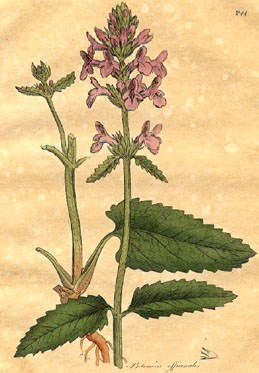 Synonyms and Common names: Betonica officinalis, Stachys
officinalis, Bishopswort, lousewort, purple betony
Synonyms and Common names: Betonica officinalis, Stachys
officinalis, Bishopswort, lousewort, purple betony
German = Betonien, French = Betoine, Spanish and Italian = Betonica
Order: Labiatae
Description: Stachys is a native British perennial which grows up to 60cm tall. The stem is square, erect, covered in coarse hairs and usually unbranched. There is a basal rosette of oblong, cordate, coarsely crenate, long-petioled leaves, up to 7cm long. Two to three pairs of smaller leaves occur further up the stem which terminates in a spike-like inflorescence with numerous tapering bracts. The bright red-purple flowers have a bell-shaped, five-lobed calyx, cleft into tapering teeth terminating in a short bristle. Stachys grows in open woodland, meadows and shrubby slopes and flowers from May to August.
Parts used: aerial parts
Collection: The aerial parts should be collected during flowering in June and July.
Constituents: alkaloids (including betonicine, trigonelline and stachydrine), betaine, choline, 15% tannins, saponins
Actions: sedative, bitter, aromatic, astringent
Indications: headache, vertigo, anxiety states, hysteria, neuralgia. Specifically indicated in neurasthenic headache.
Therapeutics and Pharmacology: Stachys is used in the treatment of nervous debility associated with anxiety and tension and to ease headaches and neuralgia of nervous origin. The astringent effect of the tannins make it a suitable compress for wounds and bruises. The powdered leaves have been used in the past as a snuff, and an infusion of the leaves is said to clear head colds. The French recommend Stachys for liver and gallbladder complaints. Taken internally, it stimulates the circulation. The alkaloid trigonelline is believed to have a hypoglycaemic action.
Combinations: Stachys may be combined with Scutellaria for nervous headache.
Caution: No contraindications are known.
Preparation and Dosage: (thrice daily)
Regulatory Status: GSL Schedule 1
Dried herb: 2-4g or by infusion
Liquid Extract: 1:1 in 25% alcohol, 2-4ml
Tincture: 1:5 in 45% alcohol, 2-6ml
Additional Comments: The physician of the Roman emperor Augustus claimed that Betony could cure at least 47 different ailments. In the past it was believed to possess the power to dispel evil and to protect the wearer from �visions and dreams�. Parkinson wrote, ��it is said also to hinder drunkenness being taken beforehand and quickly to expell it afterwards.�
Bibliography
Bartram, T. 1995 Encyclopedia of Herbal Medicine, 1st edn.,Grace Publishers, Bournemouth.
Bremness, L. 1994 Herbs, Dorling Kindersley Eyewitness Handbook, London.
BHMA 1983 British Herbal Pharmacopoeia, BHMA, Bournemouth.
Chevallier, A. 1996 The Encyclopedia of Medicinal Plants, Dorling Kindersley, London.
Grieve, M. 1931 A Modern Herbal, (ed. C.F. Leyel 1985), London.
Hoffmann, D. 1990 The New Holistic Herbal, Second Edition, Element, Shaftesbury.
Lust, J. 1990 The Herb Book, Bantam, London.
Mabey, R. (ed.) 1991 The Complete New Herbal, Penguin, London.
Ody, P. 1993 The Herb Society's Complete Medicinal Herbal, Dorling Kindersley, London.
Polunin, M. and Robbins, C. 1992 The Natural Pharmacy, Dorling Kindersley, London.
Prihoda, A. 1989 The Healing Powers of Nature, Octopus, London.
Rogers, S.K. 1995 British and Chinese Herbal Pharmacopoeia, Healthlink Software Systems, Australia
Wren, R.C. 1988 Potter's New Cyclopaedia of Botanical Drugs and Preparations, C.W.Daniel, Saffron Walden.