









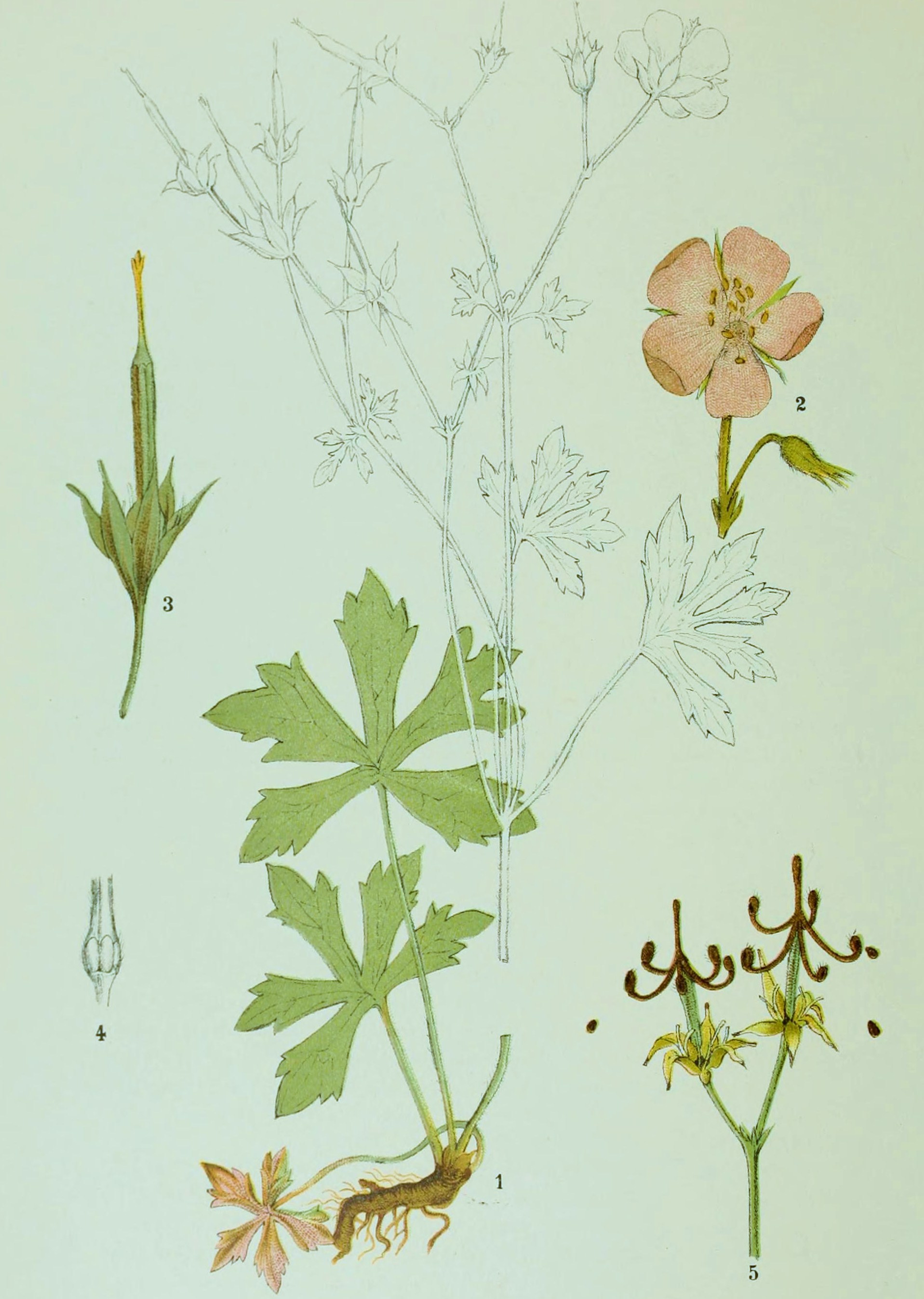
Geranium maculatum L.
 Synonyms: alumroot, storksbill, wild
geranium, geranium, wild cranesbill, spotted cranesbill, wild cranesbill, alum
bloom, chocolate flower, crowfoot, dove's foot, old maid's nightcap, shameface,
tormentil
Synonyms: alumroot, storksbill, wild
geranium, geranium, wild cranesbill, spotted cranesbill, wild cranesbill, alum
bloom, chocolate flower, crowfoot, dove's foot, old maid's nightcap, shameface,
tormentil
Order: Geraniaceae
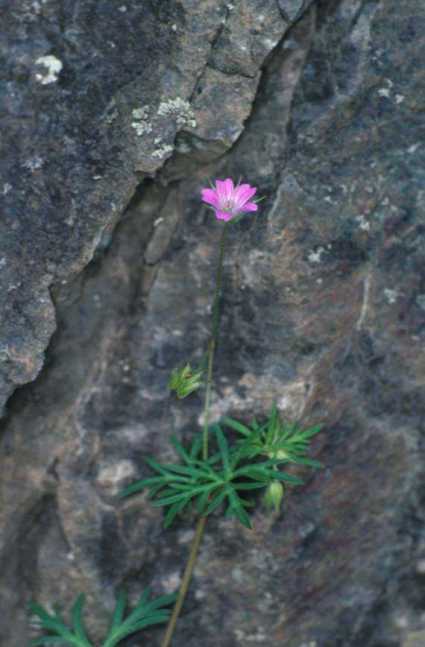
Description: This is a perennial herb, growing up to 60cm tall, and indigenous to woodlands in Canada and the Eastern and Central United States. The stem is erect and unbranched, the leaves deeply divided and toothed. Pink to purple flowers grow in pairs on axillary peduncles from April to June, giving way to an elongated 'beaked' capsule divided into five cells with a seed in each.
Parts used: aerial parts and rhizome
Collection: the aerial parts during the flowering; the rhizome in late summer and autumn.
Constituents: 12-25% tannins including gallic acid, with the level being highest just before flowering.
Actions: astringent, antihaemorrhagic, vulnerary, styptic, anti-inflammatory, tonic
Indications: diarrhoea, particularly in the young and old, dysentery, haemorrhoids.
 Therapeutics and Pharmacology: Geranium reduces
inflammation in, for example, peptic ulcer, duodenal ulcer, enteritis and bowel disease,
and is gentle enough
to be administered to children, the elderly and the infirm. It is also used to
treat melaena, menorrhagia and metrorrhagia. Topically, it can be applied
to indolent ulcers and
haemorrhoids, and as a douche for leucorrhoea. It may be used as a mouthwash and
gargle for disorders of the mouth, gums and throat. The root is more astringent
than the herb. The powdered root is an effective blood coagulant and can be used
to stem external bleeding.
Therapeutics and Pharmacology: Geranium reduces
inflammation in, for example, peptic ulcer, duodenal ulcer, enteritis and bowel disease,
and is gentle enough
to be administered to children, the elderly and the infirm. It is also used to
treat melaena, menorrhagia and metrorrhagia. Topically, it can be applied
to indolent ulcers and
haemorrhoids, and as a douche for leucorrhoea. It may be used as a mouthwash and
gargle for disorders of the mouth, gums and throat. The root is more astringent
than the herb. The powdered root is an effective blood coagulant and can be used
to stem external bleeding.
Combinations: with Geum, Agrimonia or Symphytum root in duodenal ulcer. A decoction with Trillium as 5% of the total is a suitable douche for leucorrhoea. In diarrhoea, soothing herbs such as Althaea, Filipendula or Plantago should be added to ease gut inflammation.
Preparation and Dosage: (thrice daily)
GSL
1-2g or by infusion (herb) or decoction (rhizome)
Liquid extract: 1:1 in 45% alcohol, 1-2ml
Tincture: 1:5 in 45% alcohol, 2-4ml
Additional Comments: Native Americans used a decoction of Wild grape and Cranesbill as a mouthwash for children with thrush. English Cranesbill, G.dissectum L. is reputed to have similar properties.
Bibliography
BHMA 1983 British Herbal Pharmacopoeia, BHMA, Bournemouth.
Grieve, M. 1931 A Modern Herbal, (ed. C.F. Leyel 1985), London.
Hoffmann, D. 1990 The New Holistic Herbal, Second Edition, Element, Shaftesbury.
Lust, J. 1990 The Herb Book, Bantam, London.
Mabey, R. (ed.) 1991 The Complete New Herbal, Penguin, London.
Mills, S.Y. 1993 The A-Z of Modern Herbalism, Diamond Books, London.
Ody, P. 1993 The Herb Society's Complete Medicinal Herbal, Dorling Kindersley, London.
Wren, R.C. 1988 Potter's New Cyclopaedia of Botanical Drugs and Preparations, C.W.Daniel, Saffron Walden.