




Rhamnus frangula (L)
Synonyms: Frangula bark, Frangula alnus
(Mill.), Black dogwood, Alder dogwood, European black alder, European buckthorn,
Black alder,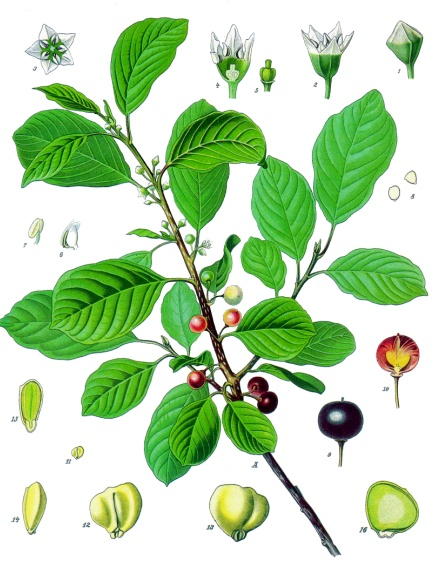 Arrow wood, Persian berries
Order: Rhamnaceae
Description: This erect shrub which grows up to 6m tall, has long upright branches with shiny brown bark and pronounced light lenticels. There are no thorns. The dark green, entirely smooth leaves turn yellow or red in autumn.. The small, greenish-white flowers arise from leaf axils in the upper branches and give way to globular berries, green turning to red and finally glossy black. Rhamnus forms dense undergrowth along with alder, spindle tree and guelder rose in damp woodland, hedgerows, marshes and swamps in England, Wales, Europe and the US preferring acid and light sand or peaty soils.
Parts used: Bark
Collection: The bark is gathered in spring and should be stored for at least a year before use, thereby allowing the anthrones to oxidise to anthraquinones. A fermentation process occurs on storage that destroys the emetic fragularoside.
Constituents: Up to 8% anthraquinones (glucofrangulin A, glucofrangulin B) derived from the aglycone frangula-emodin; glycosides, peptide alkaloids (frangulanin, franganin), tannins
Actions: Tonic, stimulating mild to medium laxative, gentle purgative, cholagogue, antiparasitic, local antiseptic
Indications: constipation
Therapeutics and Pharmacology: Rhamnus frangula is used to treat occasional constipation and conditions in which softer faeces are desirable, such as haemorrhoids. It may be given in cases of spastic constipation, it's colic-inducing effect being minimal. It may be used in obstructive conditions of the biliary tract and as a general blood cleanser for chronic toxic conditions associated with bowel or digestive disorders and it can aid regulation of disturbed bowel flora. The decoction may be used as an antiseptic mouthwash for gum disease and mouth infections, or as a rinse for infestations of the scalp.
Hydroxyanthracene glycosides are poorly absorbed from the small intestine but are hydrolysed by bacteria to the active aglycones, which are then partly absorbed in the colon. They are predominantly excreted in the faeces but also in urine, where they produce an orange colour. Anthrones and anthranols will also pass into breast milk. The hydroxyanthracene aglycones inhibit water and electrolyte absorption from the colon and induce active secretion of water and electrolytes into the intestinal lumen. Due to the increased volume of contents, intestinal pressure is increased stimulating peristalsis. The anthrones, anthranols and their glycosides are considered to be the emetic principles.
Combinations: In persistent constipation, Rhamnus can be mixed with Cassia leaves and carminative herbs such as Foeniculum.
Caution: The fresh bark causes violent griping pains, emesis and nausea. This herb should be avoided during pregnancy and lactation and if intestinal obstruction is suspected. It should be taken for short periods only (10 days) to avoid dependence.
Preparation and Dosage:
Regulatory Status: GSL
One dose or two half-doses daily, preferably at bedtime (half dose morning and night)
Dried bark: 0.5-2.5g or by decoction
Liquid Extract: 1:1 in 25% alcohol, 0.5-2.5ml
Additional Comments: The name Rhamnus is derived from the Greek rhamnos, meaning a branch. The bark and leaves of Alder Buckthorn yield a yellow dye which turns black when mixed with iron salts.
Bibliography
Bradley, P.R. (ed.) 1992 British Herbal Compendium, Volume 1, BHMA, Bournemouth.
BHMA 1983 British Herbal Pharmacopoeia, BHMA, Bournemouth.
Grieve, M. 1931 A Modern Herbal, (ed. C.F. Leyel 1985), London.
Lust, J. 1990 The Herb Book, Bantam, London.
Mills, S.Y. 1993 The Essential Book of Herbal Medicine, Penguin, London (First published in 1991 as Out of the Earth, Arkana)
Mills, S.Y. 1993 The A-Z of Modern Herbalism, Diamond Books, London.
Weiss, R.F. 1991 Herbal Medicine, Beaconsfield Arcanum, Beaconsfield.
Wren, R.C. 1988 Potter's New Cyclopaedia of Botanical Drugs and Preparations, C.W.Daniel, Saffron Walden.