







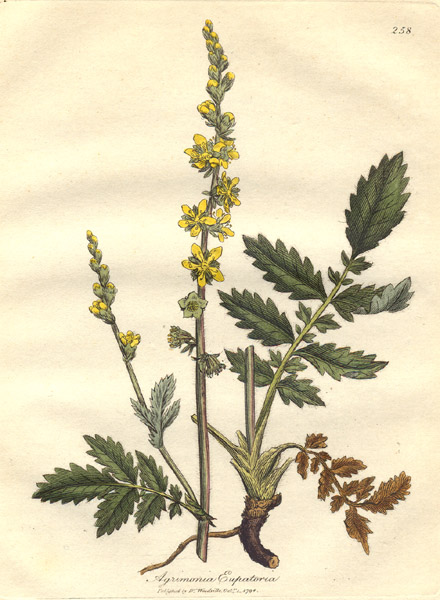
Agrimonia eupatoria (L.)
 Synonyms: common agrimony, church steeples,
cockeburr, cocklebur, stickwort, sticklewort
Synonyms: common agrimony, church steeples,
cockeburr, cocklebur, stickwort, sticklewort
Order: Rosaceae
Description: This native British perennial grows up to 60cm tall. Its reddish creeping rootstock produces a hairy erect stem which bears long spikes of bright yellow flowers 5-8mm across, arranged in the axil of a small cleft bract. The leaves are alternate pinnate and stipulate, the lower ones having 3-6 pairs of larger leaflets with 2-3 pairs of smaller leaflets in between. The leaves are resinous beneath and hairy along the veins. The fruits are enclosed within a tough capsule with a circle of hooked spines. Agrimonia grows throughout Britain, Europe, Asia and North America along roadsides, wasteland, hedges and banks.
Parts used: dried aerial parts
Collection: just before, or during the flowering period
Constituents: Up to 8% condensed tannins, coumarins, glycosidal bitters, nicotinic acid, volatile oil, around c20% polysaccharides, silica, iron, flavonoids (glucosides of luteolin, apigenin and quercetin), mucilage, phytosterols, vitamins B and K.
Actions: mild astringent, tonic, diuretic, digestive tonic, antidiarrhoeic, haemostatic, cholagogue, reputed antiviral
Indications: diarrhoea in children, mucous colitis, grumbling appendicitis, urinary incontinence, cystitis, chronic cholecystopathies with gastric sub-acidity.
Therapeutics and Pharmacology: Agrimonia is a digestive tonic; its tannins tone the mucous membranes, improving their secretion and absorption. It is of particular benefit in the treatment of irritation and infection of the digestive tract in children. It is also of use in peptic ulceration and for controlling colitis. The bitter principles regulate the liver and gallbladder function, and in Germany it has been used to treat gallstones and cirrhosis of the liver. It is indicated in gallbladder disease associated with gastric hyperacidity.
Agrimonia is also used to counter high uric acid levels in rheumatism and gout. Internally, it is used in haematuria and externally for wounds and cuts. This action is attributed to the high silica content of the herb. It can be used as a mouthwash or gargle for inflamed gums and sore throats. As a douche, it is used in the treatment of leucorrhoea and it is beneficial as an eyewash for conjunctivitis. A poultice can be used in the external treatment of varicose veins.
Combinations: with Chelone in rheumatoid arthritis; and with Compound Cardamom Tincture in atonic dyspepsia.
Caution: As the herb is astringent, it should not be taken if constipated.
Preparation and Dosage: (thrice daily)
Regulatory Status: GSL
Dried herb: 2-4g or by infusion
Liquid Extract: 1:1 in 25% alcohol, 1-3ml
Tincture: 1:5 in 45% alcohol, 1-4ml
Additional Comments: This herb is named after Mithridates Eupator, king of Pontus, who was a famous herbalist. Argemone is a Greek word given to plants which were used to treat ailments affecting the eyes. Pliny referred to it as a 'herb of princely authoritie'. The Anglo-Saxons, who called it garclive, applied it to wounds and believed it could cure warts and snakebites. Chaucer recommends egrimoyne, mugwort and vinegar for 'a bad back' and 'alle woundes'. During the 15th century it was the prime ingredient of 'arquebusade water', a battlefield remedy for gunshot wounds and it is still used today for sprains and bruises. It is an ingredient of 'spring tonics' in many parts of Europe and a popular tisane in France. The whole plant yields a yellow dye. A related variety, A. pilosa, known as xian he cao in China, is used in a similar way to A. eupatoria. It has antibacterial and antiparasitic actions and is used for Trichomonas vaginalis, tapeworm, dysentery and malaria. In traditional Chinese medicine, agrimony is a major herb for stopping bleeding and is used to treat profuse menstruation, internal bleeding and tuberculosis. Chinese research indicates that agrimony can increase blood coagulation by 50%.
Bibliography
Bae H, Kim HJ, Shin M, Lee H, Yin CS, Ra J, Kim J. 2010 Inhibitory effect of Agrimoniae Herba on lipopolysaccharide-induced nitric oxide and proinflammatory cytokine production in BV2 microglial cells. Neurol Res. 2010 Feb; 32 Suppl 1:53-7. PubMed PMID:20034446.
BHMA 1983 British Herbal Pharmacopoeia, BHMA, Bournemouth.
Cehn YS, Zhang K, Zhao SQ, Zhang JH. 2010 [Studies on the lowering blood sugar substances from agrimony (II)]. Zhong Yao Cai. 2010 May; 33 (5) :724-6. PubMed PMID:20873555.
Copland A, Nahar L, Tomlinson CT, Hamilton V, Middleton M, Kumarasamy Y, Sarker SD. 2003 Antibacterial and free radical scavenging activity of the seeds of Agrimonia eupatoria. Fitoterapia. 2003 Feb; 74 (1-2) :133-5. PubMed PMID:12628408.
Correia HS, Batista MT, Dinis TC. 2007 The activity of an extract and fraction of Agrimonia eupatoria L against reactive species. Biofactors. 2007; 29 (2-3) :91-104. PubMed PMID:17673826.
Gi�o MS, Pestana D, Faria A, Guimar�es JT, Pintado ME, Calhau C, Azevedo I, Malcata FX. 2010 Effects of extracts of selected medicinal plants upon hepatic oxidative stress. J Med Food. 2010 Feb; 13 (1) :131-6. PubMed PMID:20136446.
Grieve, M. 1931 A Modern Herbal, (ed. C.F. Leyel 1985), London.
Hoffmann, D. 1990 The New Holistic Herbal, Second Edition, Element, Shaftesbury.
Kwon DH, Kwon HY, Kim HJ, Chang EJ, Kim MB, Yoon SK, Song EY, Yoon DY, Lee YH, Choi IS, Choi YK. 2005 Inhibition of hepatitis B virus by an aqueous extract of Agrimonia eupatoria L. Phytother Res. 2005 Apr; 19 (4) :355-8. PubMed PMID:16041735.
Lee KY, Hwang L, Jeong EJ, Kim SH, Kim YC, Sung SH. 2010 Effect of neuroprotective flavonoids of Agrimonia eupatoria on glutamate-induced oxidative injury to HT22 hippocampal cells. Biosci Biotechnol Biochem. 2010; 74 (8) :1704-6. PubMed PMID:20699556.
Lust, J. 1990 The Herb Book, Bantam, London.
Mabey, R. (ed.) 1991 The Complete New Herbal, Penguin, London.
Mills, S.Y. 1993 The A-Z of Modern Herbalism, Diamond Books, London.
Ody, P. 1993 The Herb Society's Complete Medicinal Herbal, Dorling Kindersley, London.
Polunin, M. and Robbins, C. 1992 The Natural Pharmacy, Dorling Kindersley, London.
Venskutonis PR, Skemaite M, Ragazinskiene O. 2007 Radical scavenging capacity of Agrimonia eupatoria and Agrimonia procera. Fitoterapia. 2007 Feb; 78 (2) :166-8. PubMed PMID:17215090.
Weiss, R.F. 1991 Herbal Medicine, Beaconsfield Arcanum, Beaconsfield.
Wren, R.C. 1988 Potter's New Cyclopaedia of Botanical Drugs and Preparations, C.W.Daniel, Saffron Walden.
Zhang JH, Chen YS. 2009 [Studies on the lowering blood sugar substances from agrimony]. Zhong Yao Cai. 2009 Oct; 32 (10) :1537-9. PubMed PMID:20112714.